Custom Waveplates, Polarization Prisms, and Retardation Components for Research
 Figure 1. Precision planetary polishing of a thin quartz waveplate on a dedicated flatness-controlled lap.
The Optical Axis Must Be Cut, Not Guessed
In isotropic optical materials such as fused silica or BK7, light behaves the same regardless of its polarization direction. Birefringent crystals violate that symmetry. Their atomic lattice arranges itself along a preferred crystallographic axis, and light polarized parallel to that axis travels at a different speed than light polarized perpendicular to it. The difference between those two refractive indices, called the birefringence, is what makes the crystal useful. It is also what makes the crystal fiendishly difficult to fabricate.
A waveplate must be cut so that its optical axis lies precisely in the plane of the polished faces. If the axis tilts by even a few degrees, the ordinary and extraordinary beams separate in space, the retardation becomes angle-dependent, and the polarization purity of the output beam degrades. A Wollaston prism requires two wedges cemented with their optical axes perpendicular, a geometric relationship that must be established to arcsecond-level accuracy to maintain extinction ratio.
Eata Ray processes birefringent crystals exclusively for research and instrumentation applications. From X-ray orientation of raw boules through waveplate polishing, prism assembly, and retardation verification, our fabrication pipeline ensures that the crystal's internal anisotropy is translated into a precisely controlled external optical function.
Fabricating Polarization from Crystalline Anisotropy
Every birefringent component begins with a raw crystal boule whose internal lattice orientation is known but whose external geometry must be carved to match the optical prescription. Our facility maintains in-house capability across the full processing chain.
Crystallographic Orientation and Cutting
Before any material is removed, the crystallographic axes must be located with precision. Unlike isotropic glasses, birefringent crystals cannot simply be shaped by dimension. The cut must respect the optical axis.
- X-ray Laue diffraction patterns reveal the orientation of the crystallographic axes relative to the external boule surface, establishing a reference frame with sub-degree accuracy before any saw touches the material.
- For uniaxial crystals such as quartz, YVO4, and calcite, the single optical axis must be aligned parallel to the polished faces of a waveplate or along a specific prism edge. Biaxial crystals such as mica require both principal optical axes to be located and oriented.
- Diamond wire saws and inner-diameter blade cutting machines shape the oriented boule into plates, rods, prisms, and wedges while preserving the established crystallographic reference.
- For zero-order waveplates, the crystal blank must be cut to a thickness of only tens of micrometers. Achieving this without fracture requires specialized thinning techniques, including controlled etching and stress-free mechanical lapping.
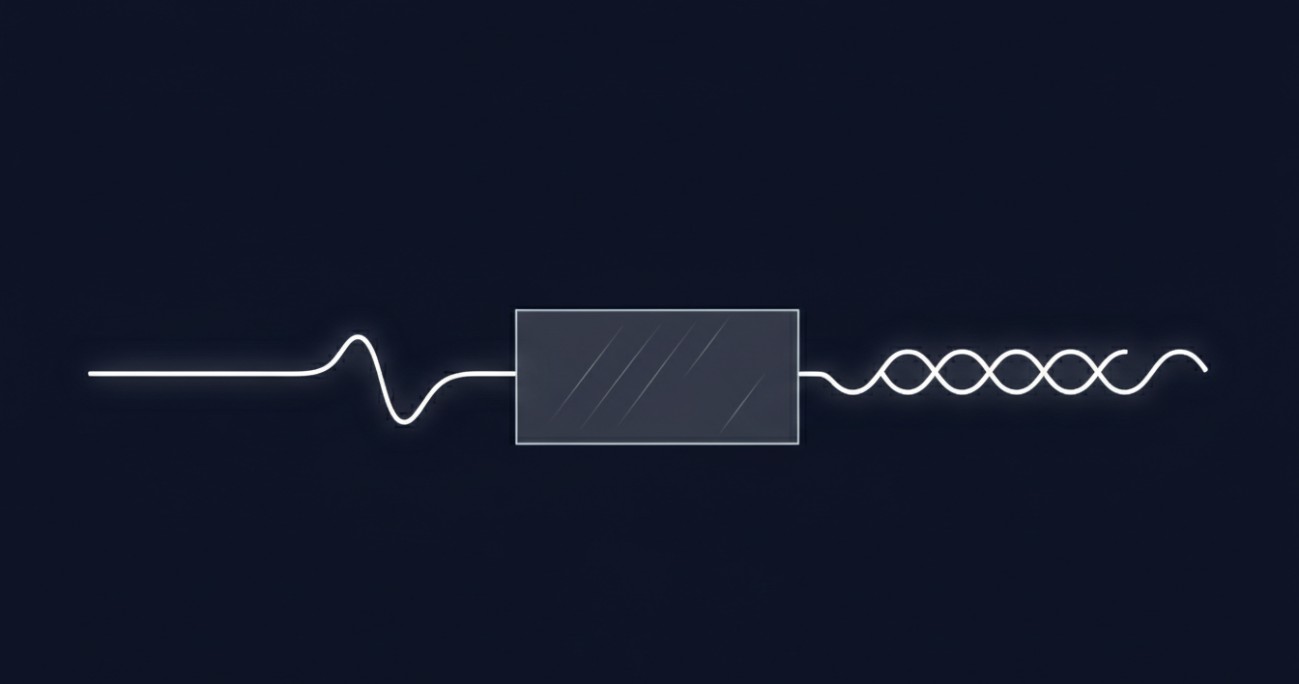 Figure 2. A linearly polarized beam entering a quarter-wave plate and emerging as circularly polarized light through phase retardation between orthogonal crystal axes.
Waveplate Fabrication
Waveplates exploit birefringence to introduce a controlled phase delay between orthogonal polarization components. The retardation depends on the difference between the ordinary and extraordinary refractive indices, the physical thickness of the plate, and the wavelength of the incident light.
- Zero-order waveplates are cut to the minimum thickness that produces the desired retardation, typically 20 to 40 micrometers for quartz at visible wavelengths. Because such thin plates are fragile, they are often bonded to a thicker undoped carrier substrate with its fast axis rotated 90 degrees, canceling the carrier's retardation while mechanically supporting the active layer.
- Multi-order waveplates use thicker blanks where the retardation includes several full waves plus the desired fractional amount. While simpler to fabricate, they are more sensitive to temperature and wavelength drift, making them suitable for stable single-wavelength laser environments.
- Achromatic waveplates combine two different birefringent materials, typically quartz and magnesium fluoride, with their fast axes opposed. The differential dispersion between the two materials partially cancels the wavelength dependence of retardation, producing a flat response across hundreds of nanometers.
- True zero-order and super-achromatic waveplates for tunable laser systems, spectropolarimetry, and broadband ellipsometry demand the tightest thickness control, often to within 0.1 micrometer, verified by spectrophotometric retardation measurement.
Birefringent Prism Manufacturing
Birefringent prisms use the anisotropy of the crystal material to split or analyze polarization states through geometric beam separation rather than thin-film interference. Their fabrication demands control over both the external prism angles and the internal optical axis orientation.
- Wollaston prisms consist of two identical wedges cemented with their optical axes perpendicular. The ordinary beam in the first wedge becomes extraordinary in the second, and vice versa, causing the two polarizations to diverge symmetrically. The angle between the output beams depends on the wedge angle and the birefringence of the material.
- Rochon prisms split the ordinary and extraordinary beams without deviating the ordinary ray, a geometry preferred for spectroscopic instruments where one polarization must remain on the optical axis.
- Nomarski prisms, used in differential interference contrast microscopy, modify the Wollaston geometry to shift the interference plane outside the prism body, enabling practical alignment with microscope objectives.
- Glan-Thompson and Glan-Taylor polarizers use calcite prisms with an air gap or cement layer to transmit the extraordinary ray while totally internally reflecting the ordinary ray, achieving extinction ratios exceeding 100,000:1.
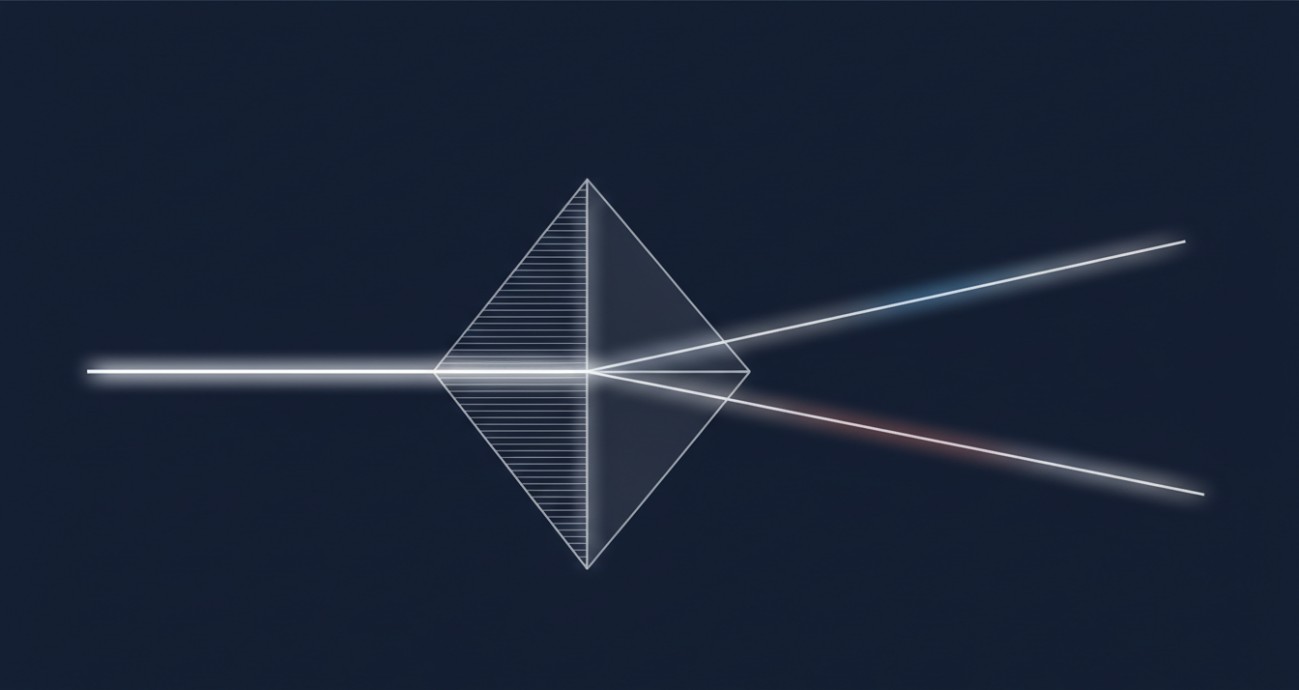 Figure 3. A Wollaston prism splitting an incident beam into two orthogonally polarized output beams through perpendicular optical axis orientations in its cemented wedges.
Material Portfolio
The choice of birefringent material determines the spectral range, the retardation per unit thickness, and the thermal stability of the finished component. Our processing capability spans the full catalog of commercially available birefringent crystals.
- Quartz (crystalline SiO2) is the most widely used waveplate material, offering moderate birefringence, excellent optical homogeneity, and transparency from the deep ultraviolet to the near-infrared. Its positive uniaxial structure and zero-order capability make it the default for high-purity polarization control.
- Calcite (CaCO3) provides the highest birefringence of any common optical material, enabling compact polarizing prisms and wide-angle beam splitters. Its negative uniaxial structure and large birefringence make it indispensable for Glan-type polarizers and high-shear DIC prisms.
- Yttrium orthovanadate (YVO4) offers birefringence comparable to calcite with superior mechanical durability and easier polishability, serving as a preferred alternative for compact polarizing beam splitters and high-power waveplates.
- Magnesium fluoride (MgF2) combines transparency from the ultraviolet through the mid-infrared with moderate birefringence, making it the material of choice for achromatic waveplate pairs and broadband retarders.
- Rutile (TiO2) provides very high birefringence with excellent thermal stability, useful for applications requiring large retardation in a thin profile.
- Mica and organic crystals offer natural cleavage planes and high birefringence for ultra-thin waveplates and full-wave compensators in microscopy.
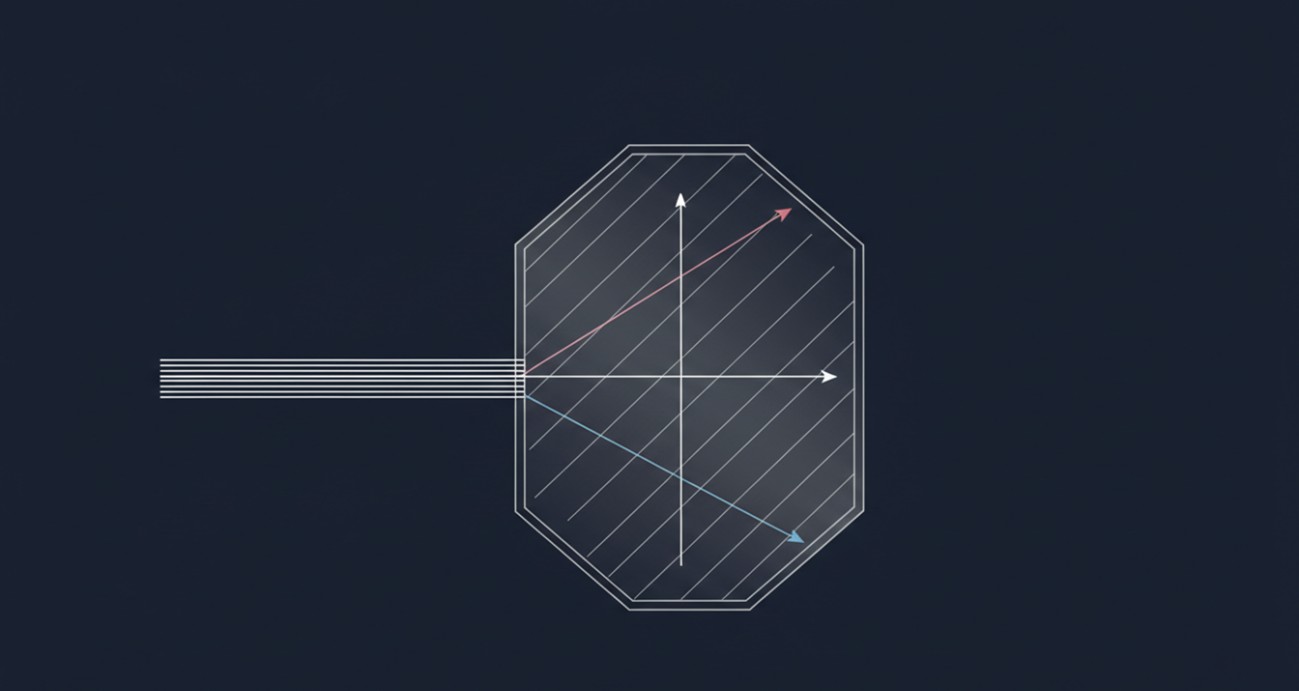 Figure 4. A uniaxial crystal splitting an incident beam into ordinary and extraordinary rays that propagate at different velocities through the aisotropic lattice.
Anti-Reflection and Functional Coatings
An uncoated birefringent crystal reflects approximately 4 percent per surface, and the reflection coefficients differ slightly for the ordinary and extraordinary polarizations. In a multi-element polarization system, these losses compound and create ghost images that degrade extinction ratio.
- Broadband anti-reflection coatings for quartz and MgF2 waveplates suppress reflection to below 0.5 percent per surface across the visible and near-infrared, preserving both transmission and polarization purity.
- Dual-wavelength coatings for harmonic generation systems simultaneously optimize transmission at the fundamental and harmonic wavelengths, common in Nd:YAG and Ti:sapphire laser chains.
- High-damage-threshold coatings deposited by ion beam sputtering withstand intensities exceeding 10 gigawatts per square centimeter for ultrafast laser applications where pulse compression and polarization control must coexist.
- Hydroscopic crystal protection for calcite and other moisture-sensitive materials prevents surface degradation and clouding that would otherwise scatter light and reduce contrast.
Specifications and Achievable Tolerances
Research-grade birefringent components must satisfy a multidimensional specification space combining crystallographic orientation, retardation accuracy, surface quality, and coating performance. The table below summarizes the ranges our standard processing workflows routinely achieve.
| Parameter |
Range / Options |
Notes |
| Crystal Materials |
Quartz, calcite, YVO4, MgF2, rutile, mica |
Other birefringent materials on request |
| Component Type |
Waveplate, prism, compensator, polarizer |
Zero-order, multi-order, achromatic |
| Diameter / Aperture |
3 mm to 50 mm |
Rectangular and custom shapes available |
| Optical Axis Alignment |
< 0.5° |
X-ray Laue verified before cutting |
| Thickness Tolerance |
±0.5 µm (ZO), ±2.0 µm (MO) |
Critical for retardation accuracy |
| Retardation Tolerance |
λ/300 to λ/500 |
At design wavelength and 22°C |
| Surface Flatness |
≤λ/10 @ 633 nm |
λ/20 for high-extinction polarizers |
| Surface Quality |
10/5 to 40/20 scratch-dig |
Per MIL-PRF-13830B |
| Parallelism |
< 10 arcsec |
< 1 arcsec for etalon-critical waveplates |
| Extinction Ratio |
> 100,000:1 (prisms) |
> 10,000:1 (waveplates with AR) |
| AR Coating Reflectance |
< 0.25% per surface |
BBAR, V-coat, dual-wavelength |
Research Applications We Enable
Birefringent components fabricated at Eata Ray have been integrated into instruments where precise polarization control determines measurement fidelity. Representative application domains include:
- Interferometric metrology: Zero-order quartz waveplates with lambda/500 retardation tolerance for phase-shifting interferometers, white-light interferometers, and holographic displacement sensors where polarization purity governs fringe contrast.
- Differential interference contrast microscopy: Nomarski and Wollaston prisms with precisely controlled shear angles for biological and materials-science imaging, where the prism geometry determines the optical path gradient sensitivity.
- Laser polarization control: Dual-wavelength AR-coated half-wave and quarter-wave plates for Nd:YAG, Ti:sapphire, and fiber laser systems, enabling rotation, conversion, and isolation of polarization states.
- Spectropolarimetry and ellipsometry: Achromatic and super-achromatic waveplates spanning 400 to 1700 nanometers for astronomical spectropolarimeters, thin-film ellipsometers, and optical activity measurements.
- Quantum optics and entanglement: Ultra-low-retardance-tolerance waveplates for Bell-state analysis, tomographic reconstruction of quantum states, and polarization-encoded quantum key distribution.
- Fiber-optic communication: YVO4 and calcite-based polarizing beam splitters and circulators for coherent detection, polarization-mode-dispersion compensation, and polarization-diversity receivers.
Verification and Retardation Metrology
A birefringent component cannot be accepted until its retardation, extinction ratio, and optical axis orientation have been quantified against traceable standards. Our metrology suite provides that confidence.
Spectrophotometric retardation measurement places the waveplate between crossed or parallel polarizers and records the transmission spectrum as a function of wavelength. The spacing between transmission maxima reveals the birefringence and thickness with sub-nanometer precision.
Null ellipsometry measures the polarization change introduced by the sample, extracting both retardation and fast-axis orientation simultaneously, the most accurate method for ultra-thin or ultra-low-retardance components.
Extinction ratio measurement with a rotating polarizer-analyzer pair quantifies the polarization purity of prisms and polarizers, confirming that the device rejects the undesired polarization state by the specified factor.
Phase-shifting interferometry maps surface flatness and transmitted wavefront error, revealing figure deviations that would otherwise scatter light and depolarize the output beam.
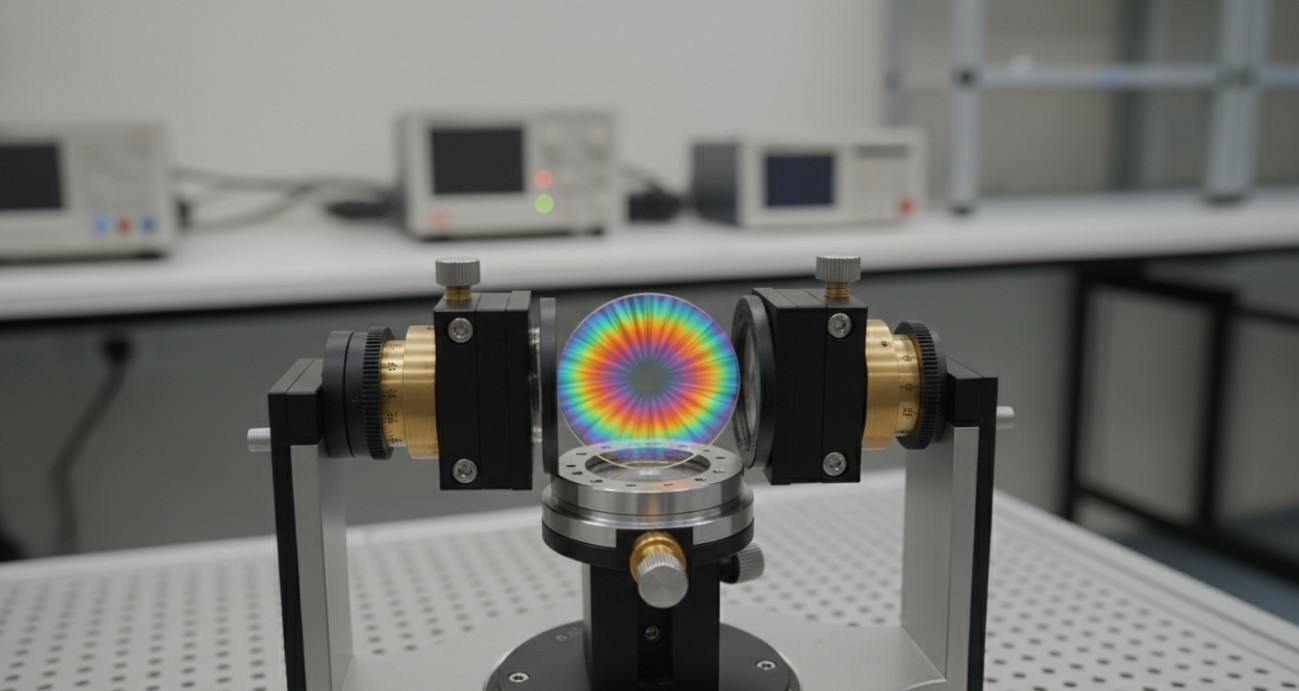 Figure 5. A waveplate mounted between crossed polarizers in our metrology lab, with rainbow interference fringes revealing the spatial retardation uniformity across the clear aperture.
Collaborative Engagement
Research birefringent components are almost never catalog items. The material, retardation, aperture, and coating must be matched to a specific optical system and experimental objective. Our engagement model is built for that specificity.
- Technical Dialogue: Share your operating wavelength, desired retardation or prism geometry, beam diameter, and any constraints on size or mounting. If you are uncertain about zero-order versus multi-order trade-offs, we advise based on wavelength stability, temperature range, and power density.
- Orientation and Process Planning: Our engineers measure the raw crystal boule orientation, calculate the required thickness or prism angle for your target retardation, and select the most appropriate material based on birefringence, dispersion, and environmental stability.
- Prototype Fabrication: For novel designs or first-time materials, a single prototype waveplate or prism allows you to validate retardation accuracy, extinction ratio, and optical axis alignment in your instrument before scaling up.
- Comprehensive Characterization: Each finished component undergoes the full metrology protocol appropriate to its specification. You receive spectrophotometric retardation data, extinction ratio verification, interferometric surface maps, and coating spectral scans.
- Integration Support: Our role extends beyond shipment. We remain available to advise on mounting methodology, thermal drift compensation, cleaning protocols, and re-coating strategies throughout the operational lifetime of your component.
Begin with Your Polarization Challenge
If your research requires a waveplate with retardation accuracy measured in fractions of a wavelength, a polarizing prism with extinction ratio exceeding 100,000 to 1, or an achromatic retarder spanning the visible to near-infrared, our team is prepared to translate your polarization specification into a verified, characterized optical component.
Reach out with your birefringent crystal requirements and receive a tailored technical assessment at no initial charge.


