Custom Second-Harmonic Generation Crystal Fabrication for Research and Advanced Laser Systems
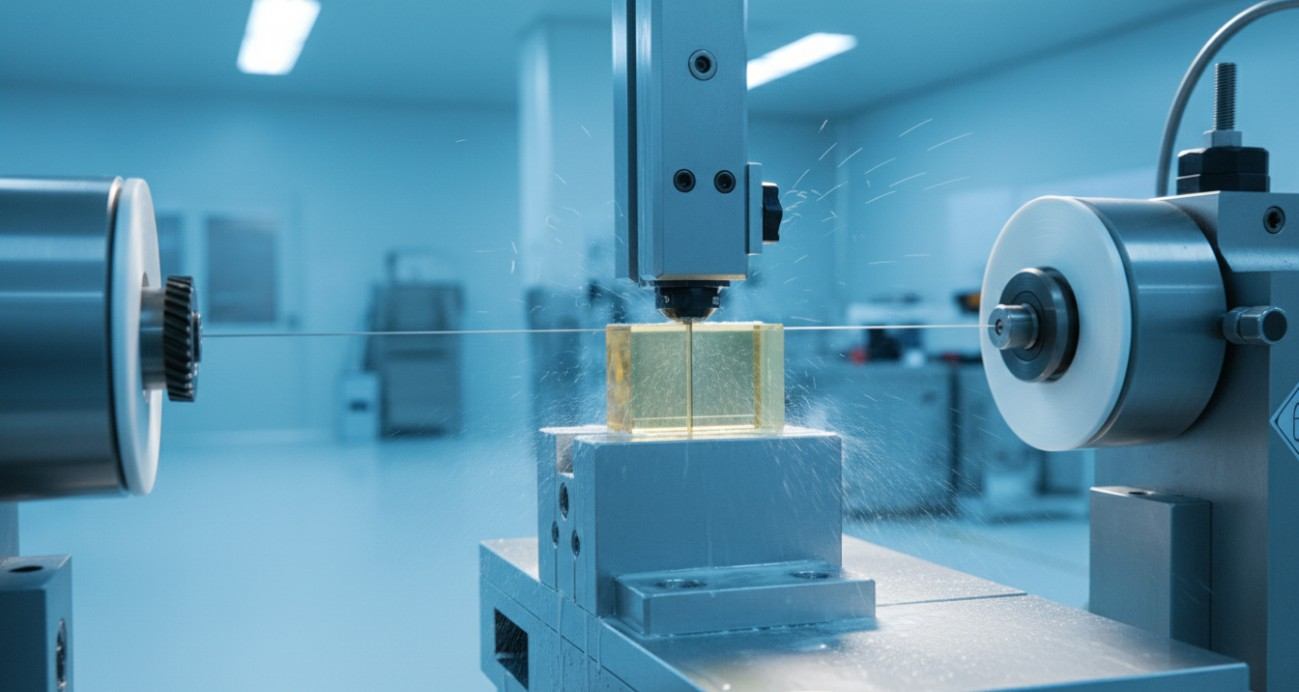 Figure 1. Precision diamond wire saw slicing a nonlinear optical crystal blank along the phase-matching orientation.
Half the Wavelength, Twice the Demand on Precision
Second-harmonic generation is deceptively simple in concept. Two infrared photons enter a crystal, a single green photon exits. Yet the conditions under which this occurs are extraordinarily sensitive. The crystal orientation must satisfy the phase-matching condition to within a fraction of a degree. The end faces must be flat enough that the pump and harmonic beams remain collinear over the entire crystal length. The coating must simultaneously transmit the pump and transmit the harmonic while reflecting neither. A failure in any one of these dimensions collapses the conversion efficiency from tens of percent down to fractions of a percent.
At Eata Ray, we fabricate frequency-doubling crystals exclusively for research and advanced instrumentation. Every cut angle, polish specification, and coating design is validated against the nonlinear optical requirements of your laser system, not merely against generic optical tolerances. Whether your goal is a compact green source for a confocal microscope or a multi-hundred-watt ultraviolet beam for materials processing, our processing pipeline delivers crystals whose phase-matching geometry, surface quality, and spectral coatings align with your power level and beam quality requirements.
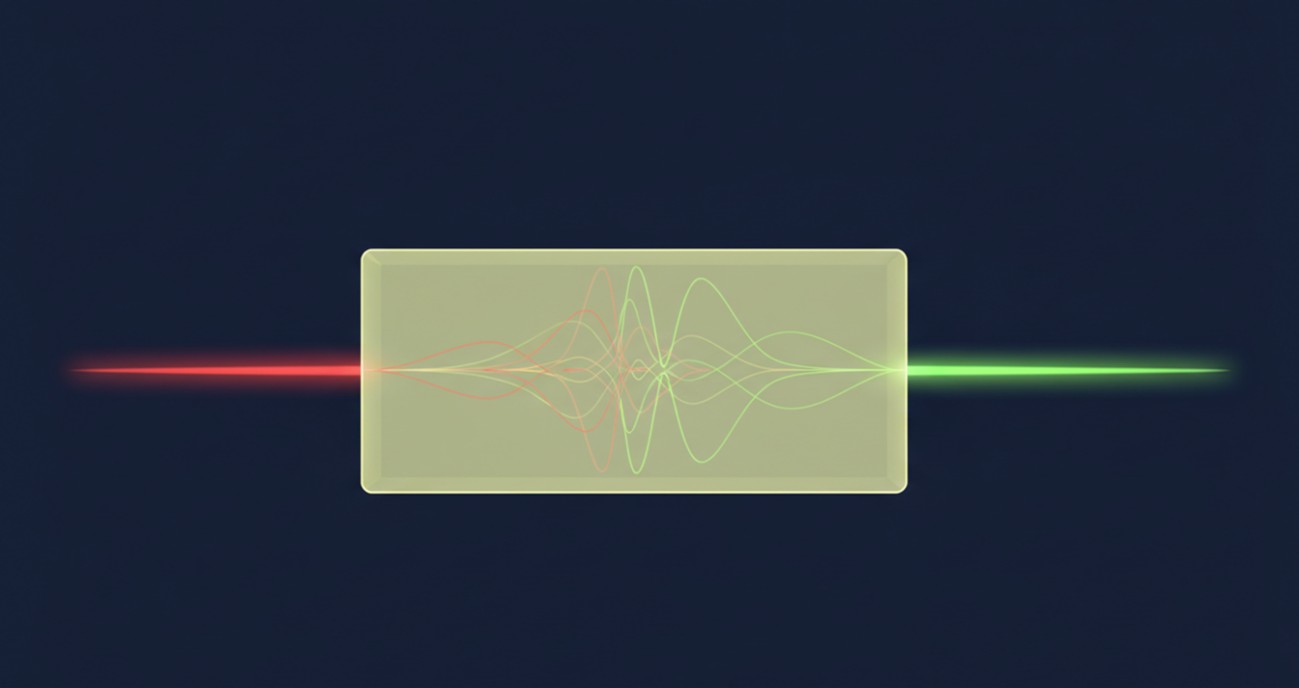 Figure 2. A nonlinear crystal converting two infrared pump photons into a single frequency-doubled photon through second-harmonic generation.
Material Selection for Your Pump Wavelength
The choice of frequency-doubling material is dictated by the pump wavelength, the desired output wavelength, the available pump power, and the acceptable walk-off angle. Each material offers a unique combination of nonlinear coefficient, transparency range, angular acceptance bandwidth, and damage threshold. Our processing capability spans the full catalog of SHG crystals.
- BBO is the most versatile frequency-doubling material for ultraviolet and visible generation. Its wide transparency from 190 nanometers to 3500 nanometers, high damage threshold, and acceptance of both type-I and type-II phase matching make it the default choice for Ti:sapphire, Yb-doped fiber, and Nd:YAG second and third harmonic generation. Its negative uniaxial structure supports critical phase matching with moderate walk-off.
- LBO combines a high damage threshold with a small walk-off angle and broad angular acceptance, making it ideal for high-average-power green and blue sources where beam quality must be preserved. Its non-hygroscopic nature eliminates the sealed-housing requirement, simplifying thermal management in kilowatt-class systems.
- KTP and its periodically poled variant PPKTP provide the highest effective nonlinear coefficient for near-infrared-to-visible conversion. Type-II phase matching at room temperature converts 1064 nanometers to 532 nanometers with conversion efficiencies exceeding 60 percent in pulsed systems. The periodically poled variant removes the walk-off limitation entirely, enabling longer interaction lengths and higher single-pass efficiency.
- PPLN and MgO:PPLN offer quasi-phase-matched frequency doubling across the 400 to 5000 nanometer transparency range with the full d33 nonlinear coefficient. Fan-out gratings enable wavelength tuning by lateral translation, while chirped gratings support ultrashort-pulse compression simultaneously with frequency conversion.
- KDP and DKDP remain the standard for large-aperture, high-energy frequency converters in fusion laser systems. Their high optical uniformity and well-characterized nonlinear properties support apertures exceeding 100 millimeters and output energies in the kilojoule range at 527 nanometers.
Processing Chain
Frequency-doubling crystal fabrication is a multi-stage process in which each operation must preserve the crystallographic orientation, surface quality, and environmental stability required for efficient nonlinear conversion.
Orientation-Critical Cutting
The phase-matching angle for frequency doubling is calculated from the Sellmeier equations of the material and the pump wavelength. For a Nd:YAG laser at 1064 nanometers, type-I BBO requires a theta angle near 22.8 degrees. A one-degree error in this cut reduces the conversion efficiency by more than half.
- X-ray Laue diffraction orientation measurement confirms the crystallographic axes before cutting, establishing a reference frame with sub-degree accuracy.
- Diamond wire saw or inner-diameter blade cutting follows the calculated phase-matching orientation, holding angular tolerances within 0.25 degrees. For biaxial crystals such as LBO, both theta and phi angles must be precisely controlled.
- For periodically poled materials such as PPLN and PPKTP, the poling period is lithographically defined after cutting and polishing, with grating periods ranging from 4 micrometers for visible generation to 30 micrometers for mid-infrared difference-frequency mixing.
Polishing and Surface Figure Control
The end faces of a frequency-doubling crystal must simultaneously satisfy flatness, parallelism, and surface quality requirements. Wavefront distortion broadens the focal spot and reduces peak intensity, directly degrading conversion efficiency which scales quadratically with pump intensity.
- Single-sided pitch polishing achieves end-face flatness of lambda/10 or better, with surface quality of 10/5 scratch-dig for high-power applications.
- Parallelism between end faces is held to better than 10 arcseconds, ensuring that the pump and harmonic beams remain collinear over the full crystal length without walk-off-induced beam separation.
- Subsurface damage removal is critical because residual fractures scatter both pump and harmonic light, creating loss and potentially seeding laser-induced damage at high intensities.
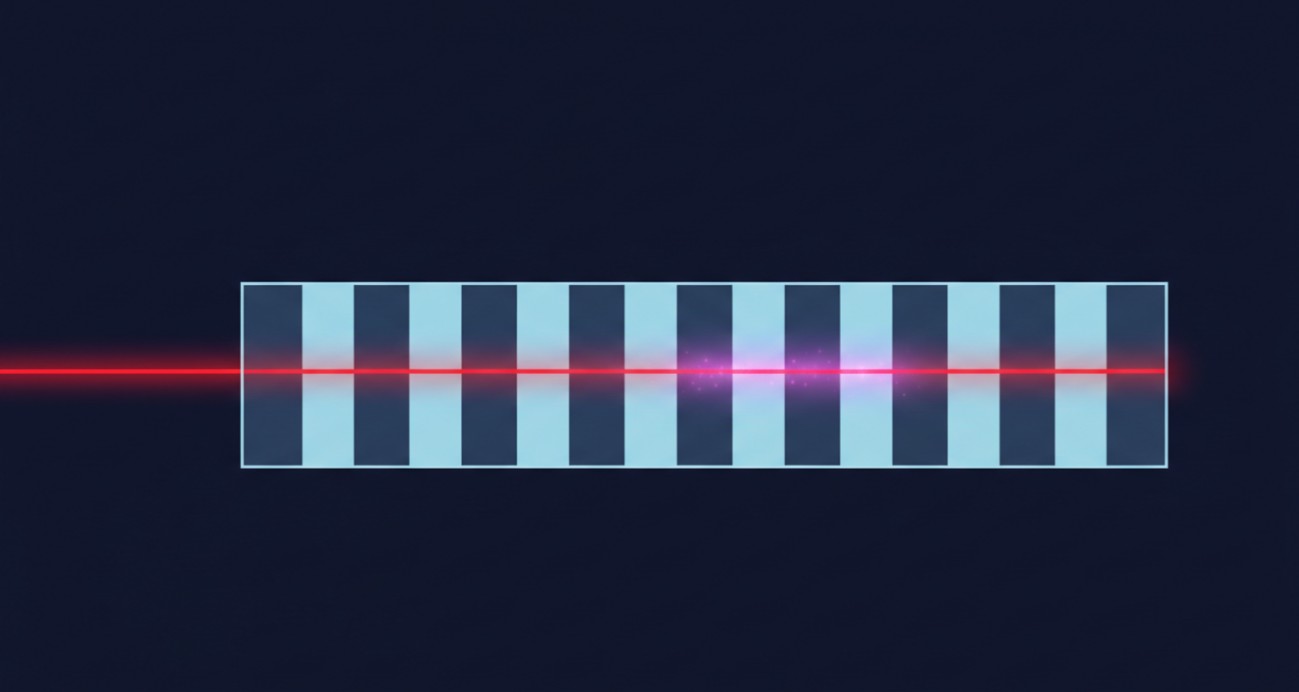 Figure 3. A periodically poled lithium niobate crystal with alternating ferroelectric domains enabling quasi-phase-matched frequency doubling without spatial walk-off.
Dual-Wavelength Anti-Reflection Coatings
An uncoated frequency-doubling crystal reflects approximately 4 percent at each surface at both wavelengths. For a single-pass doubling crystal, 8 percent reflection at the input face alone represents lost pump power that never participates in the nonlinear process. For intracavity doubling, these reflections create parasitic resonances that destabilize the laser.
- Dual-band anti-reflection coatings are optimized for both the fundamental and harmonic wavelengths simultaneously, achieving reflectivity below 0.25 percent per surface at each wavelength. These coatings are essential for efficient single-pass and intracavity frequency doublers.
- Dual-band high-reflection coatings on one face and anti-reflection on the other create monolithic cavity mirrors for compact green microchip lasers, where the crystal itself serves as both the nonlinear converter and the output coupler.
- Ion beam sputtering produces dense, high-damage-threshold films for high-peak-power picosecond and femtosecond systems where coating absorption must be minimized to prevent thermal detuning of the phase-matching condition.
- Protective coatings for hygroscopic crystals such as KDP, BBO, and LBO prevent moisture-induced degradation that would otherwise cloud surfaces and reduce conversion efficiency over months of exposure.
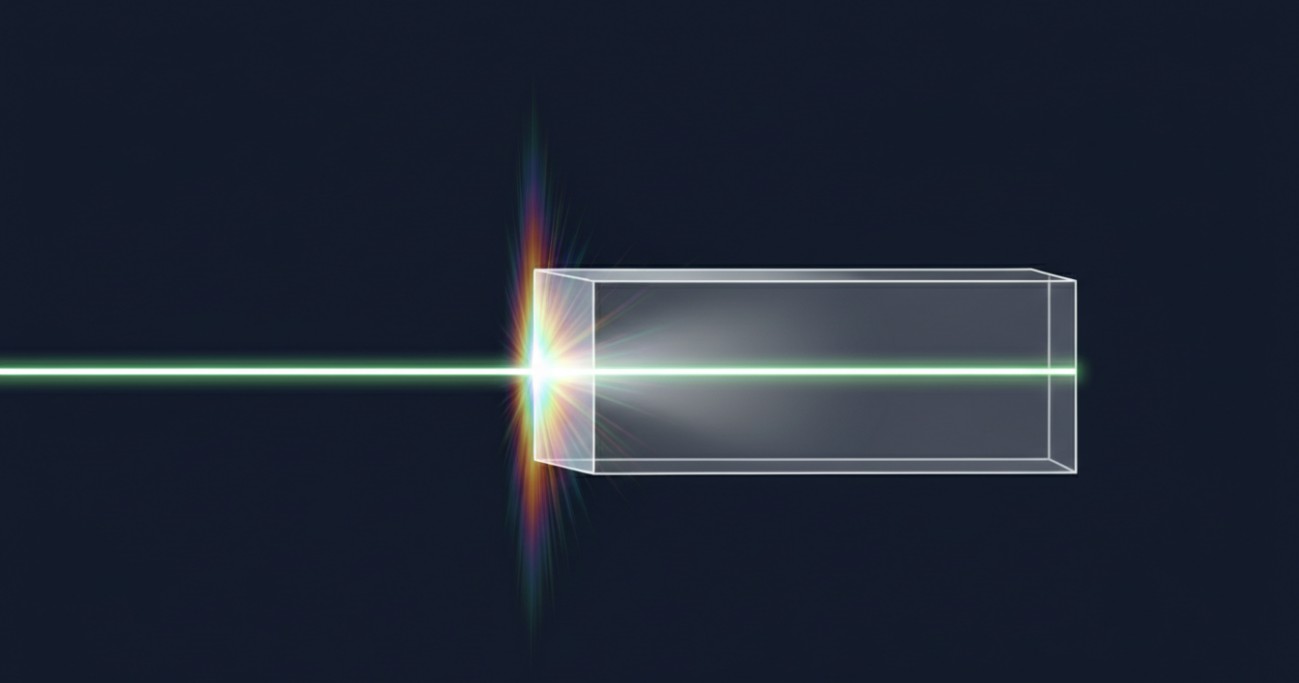 Figure 4. A dual-wavelength anti-reflection coating on a nonlinear crystal surface, minimizing reflection losses at both the pump and harmonic wavelengths.
Specifications and Achievable Tolerances
Research-grade frequency-doubling crystals must satisfy a multidimensional specification space. The table below outlines the ranges our standard processing workflows routinely achieve.
| Parameter |
Range / Options |
Notes |
| Crystal Materials |
BBO, LBO, KTP, PPKTP, PPLN, MgO:PPLN, KDP, DKDP |
Other materials on request |
| Length |
0.2 mm to 50 mm |
Longer lengths for QPM materials |
| Aperture |
2 mm to 30 mm |
Clear aperture >90% of cross-section |
| Phase-Matching Angle |
Δθ ≤ ±0.25° |
Tighter for narrow-bandwidth crystals |
| Surface Flatness |
≤λ/10 @ 633 nm |
λ/20 for wavefront-critical systems |
| Surface Quality |
10/5 to 40/20 scratch-dig |
Per MIL-PRF-13830B |
| Parallelism |
< 20 arcsec |
< 5 arcsec for etalon-sensitive applications |
| Transmitted Wavefront |
< λ/8 @ 633 nm |
< λ/4 for long crystals |
| Coating Types |
DBAR, V-coat, dual-band AR, HR/HT |
IBS and ion-assisted deposition |
| Coating Reflectance |
< 0.25% per surface |
At design wavelengths |
| Poling Period (PPLN) |
4 µm to 30 µm |
Fan-out and chirped designs available |
Research Applications We Enable
Frequency-doubling crystals processed at Eata Ray have been integrated into instruments pushing the boundaries of coherent short-wavelength generation. Representative application areas include:
- Ultrafast harmonic generation: BBO and LBO crystals with lambda/10 flatness and dual-wavelength AR coatings for second and third harmonic generation of Ti:sapphire and Yb-doped fiber amplifiers, producing femtosecond pulses in the visible and ultraviolet for time-resolved spectroscopy.
- Compact visible laser sources: PPKTP and MgO:PPLN crystals with periodically poled domain structures for efficient green and blue generation from compact diode-pumped Nd:YAG and Yb:YAG oscillators, used in confocal microscopy, flow cytometry, and laser projection.
- High-power industrial harmonics: LBO and DKDP crystals with large apertures and high-damage-threshold coatings for multi-hundred-watt green and ultraviolet sources used in semiconductor lithography, flat-panel display manufacturing, and precision materials processing.
- Intracavity frequency doubling: Monolithic KTP and MgO:PPLN crystals with sub-millimeter lengths and super-polished faces for compact green microchip lasers, where the nonlinear crystal resides inside the resonator and benefits from the high circulating power.
- Quantum and atomic physics: PPLN waveguides with conversion efficiencies exceeding 50 percent for generating 780-nanometer and 532-nanometer light from telecom-band pumps, used in rubidium and cesium atom trapping, optical lattice clocks, and entangled-photon-pair sources.
- Medical and biomedical imaging: BBO and LBO crystals with broadband UV coatings for generating 355-nanometer and 266-nanometer light for fluorescence microscopy, DNA sequencing, and ophthalmic photocoagulation systems.
Verification and Characterization
A frequency-doubling crystal must be validated at multiple levels before it can be trusted in a laser system. Our metrology suite provides the quantitative data that separates a marginal component from a research-grade one.
X-ray diffractometry confirms the crystallographic orientation relative to the polished faces, verifying that the phase-matching angle has been achieved within the specified tolerance.
Phase-shifting interferometry maps surface flatness and transmitted wavefront error, revealing figure deviations that would distort the pump beam and reduce the peak intensity at the focal point.
Spectrophotometry validates dual-wavelength coating performance, confirming that reflection minima align with both the pump and harmonic wavelengths and that absorption losses remain within specification.
For periodically poled crystals, electro-optic microscopy and second-harmonic imaging verify the domain structure, confirming that the poling period, duty cycle, and domain uniformity meet the design values across the full aperture.
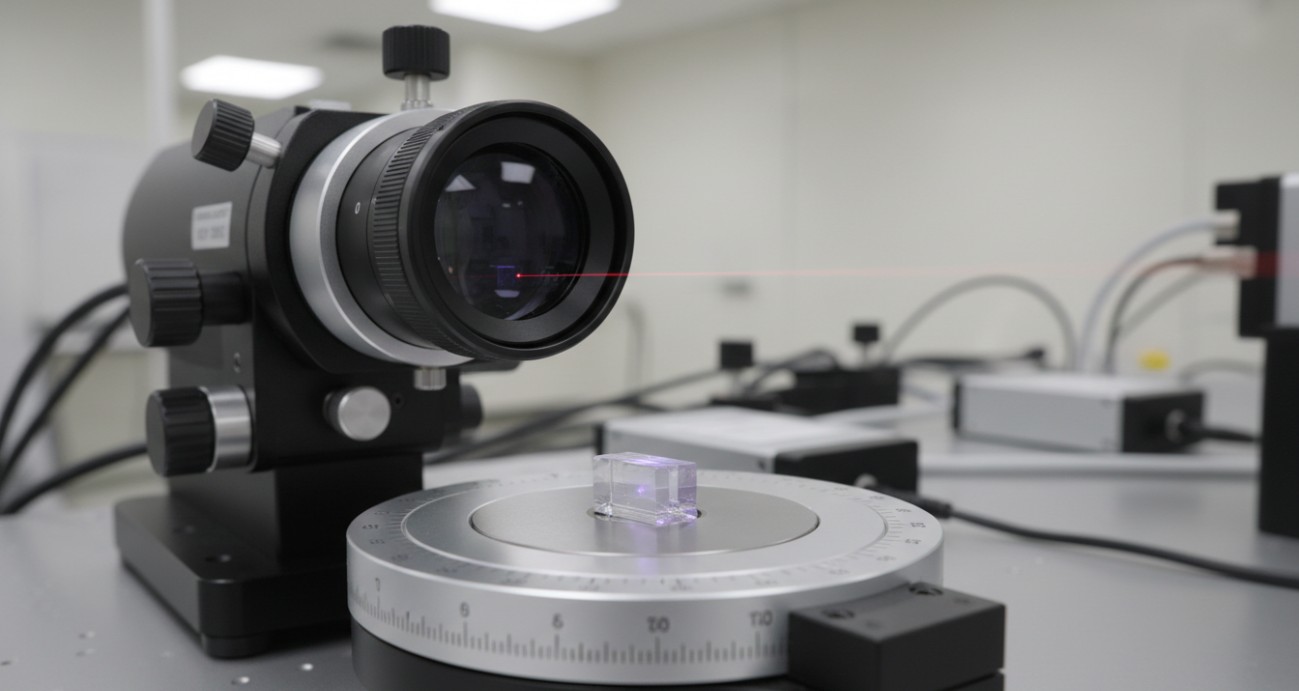 Figure 5. An autocollimator measuring the angular orientation of a nonlinear crystal on a precision rotation stage, verifying the phase-matching cut angle.
Collaborative Processing
Research frequency doublers are almost never catalog items. The crystal material, length, coating, and poling period must all be matched to a specific laser system and target wavelength. Our engagement model is designed for that specificity.
- Technical Consultation: Provide your pump wavelength, target harmonic wavelength, operating power level, and pulse duration. If you are uncertain about material selection, we advise based on nonlinear coefficient, walk-off angle, angular acceptance bandwidth, and damage threshold.
- Phase-Matching Design: Our engineers calculate the optimal phase-matching angle using temperature-dependent Sellmeier equations, recommend crystal length based on your pump power and beam size, and specify the coating architecture for your wavelengths.
- Prototype Fabrication: A single prototype crystal is typically the most prudent first step. We fabricate, coat, and characterize the component so you can validate conversion efficiency, angular acceptance, and temperature tuning in your laser system.
- Complete Characterization: Each finished crystal ships with a full inspection report including X-ray orientation data, interferometric surface maps, coating spectral scans, and second-harmonic imaging for periodically poled devices.
- Iterative Refinement: If the prototype reveals a need for adjustment, whether to crystal length, coating wavelength, or poling period, we modify the design and produce a revised iteration.
Discuss Your Frequency-Doubling Requirements
Whether you need a single BBO crystal for doubling a Ti:sapphire oscillator, a periodically poled MgO:PPLN waveguide for a compact green source, or a large-aperture DKDP assembly for high-energy harmonic conversion, our team is prepared to translate your wavelength-conversion specification into a characterized, ready-to-use nonlinear component.
Reach out with your frequency-doubling challenge and receive a tailored technical assessment at no initial charge.


