Custom Faraday Rotator and Optical Isolator Crystal Fabrication for Research
 Figure 1. Precision diamond wire saw slicing a TGG magneto-optical crystal boule along the crystallographic axis.
Where a Magnetic Field Bends Light
In 1845, Michael Faraday discovered that a magnetic field could rotate the plane of polarization of light passing through a piece of heavy glass. That phenomenon, now bearing his name, underpins every optical isolator, circulator, and Faraday rotator in modern photonics. The rotation angle depends on the Verdet constant of the material, the magnetic field strength, and the optical path length. Yet the practical realization of this effect in a research-grade device depends critically on the physical quality of the crystal itself.
A magneto-optical crystal with poor surface flatness distorts the wavefront of the polarized beam, degrading the extinction ratio of the downstream polarizer and allowing back-reflected light to leak into the laser cavity. A crystal with excessive absorption converts pump photons into heat, inducing thermal lensing that shifts the Faraday rotation angle and destabilizes the isolation. Subsurface damage left by aggressive grinding acts as a nucleation site for laser-induced damage, limiting the peak power the device can handle before catastrophic failure.
Eata Ray processes magneto-optical crystals exclusively for research and advanced instrumentation applications. From boule-grown TGG through polished Faraday rotator rods and coated optical isolator assemblies, our fabrication pipeline delivers components whose rotation angle, extinction ratio, wavefront fidelity, and damage threshold align with your optical system's most demanding specifications.
Material Portfolio and Selection Guidance
The choice of magneto-optical material determines the operating wavelength band, the achievable rotation angle per unit length, the thermal stability, and the laser damage threshold. Our processing capability spans the full catalog of commercially available magneto-optical crystals.
TGG and TSAG
TGG (terbium gallium garnet) is the dominant magneto-optical material for the 400 to 1100 nanometer band. With a Verdet constant of approximately 40 radians per Tesla per meter at 1064 nanometers, it provides strong polarization rotation in compact geometries. Its isotropic cubic structure eliminates birefringent walk-off, and its high thermal conductivity enables stable operation under multi-watt average pump loads.
TSAG (terbium scandium aluminum garnet) offers an approximately 20 percent higher Verdet constant than TGG along with a 30 percent lower absorption coefficient, extending the useful wavelength range toward 1600 nanometers and reducing thermal lensing in high-power isolators. Its cubic isotropic structure makes it fully compatible with standard TGG-based isolator designs while delivering superior performance.
YIG and Bismuth-Substituted Garnets
For applications beyond 1100 nanometers, where TGG and TSAG become increasingly absorptive, YIG (yttrium iron garnet) and its bismuth-substituted variants provide the requisite transparency. YIG is ferrimagnetic, exhibiting spontaneous magnetization that eliminates the need for external magnet arrays in compact device configurations.
BIG (bismuth iron garnet) films deposited on garnet substrates enable the fabrication of planar waveguide isolators and magneto-optical modulators for integrated photonics, where millimeter-scale bulk crystals would be incompatible with chip-scale geometries.
Magneto-Optical Glass
For applications where cost, aperture size, or fabrication complexity must be minimized, magneto-optical glasses such as MFR-1 and FR-5 offer Verdet constants roughly 30 percent of TGG with excellent optical homogeneity and freedom from crystallographic orientation constraints. Glasses are the material of choice for large-aperture isolators in high-energy laser chains and for educational demonstrations of the Faraday effect.
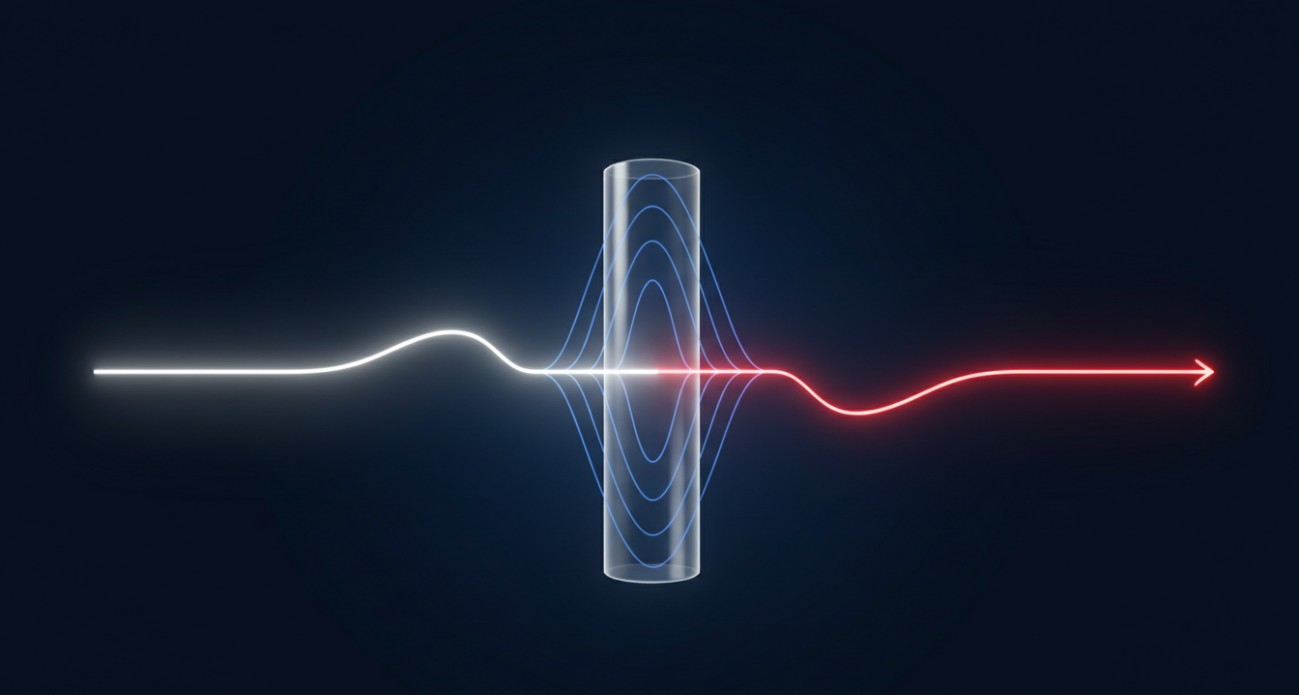 Figure 2. The Faraday effect: an incident polarized beam enters a magneto-optical crystal within a magnetic field and exits with its polarization plane rotated.
Processing Chain from Boule to Rotator
Magneto-optical crystal fabrication combines the crystallographic precision of laser crystal processing with the environmental sensitivity of nonlinear optics. TGG and TSAG are brittle, hygroscopic, and chemically reactive, demanding careful handling at every stage.
Orientation-Critical Cutting
TGG and TSAG are grown as cubic garnets, typically along the [111] or [100] crystallographic axis. For Faraday rotator applications, the crystal rod is cut with its cylindrical axis aligned to the growth direction, ensuring isotropic optical behavior and uniform Verdet constant across the aperture.
- X-ray Laue diffraction orientation measurement confirms the crystallographic axes before cutting, establishing the reference frame with sub-degree precision.
- Diamond wire saw cutting shapes rods, disks, and rectangular slabs from the oriented boule, with dimensional tolerances held to 50 micrometers or tighter.
- Because TGG is brittle and prone to chipping, cutting parameters are optimized for low feed rate and high coolant flow, preserving edge integrity and minimizing subsurface fracture.
End-Face Polishing
The end faces of a Faraday rotator must simultaneously satisfy flatness, parallelism, and surface quality requirements. Scatter from surface defects depolarizes the beam, degrading the extinction ratio. Wavefront distortion from poor flatness broadens the focal spot and reduces isolation at the system level.
- Single-sided pitch polishing on planetary laps achieves end-face flatness of lambda/10 or better at 633 nanometers, with surface quality of 10/5 scratch-dig for high-power laser isolators.
- Parallelism between end faces is held to better than 10 arcseconds, verified by autocollimator throughout the process, ensuring that the rod does not introduce wedge-induced beam steering when mounted in a magnet assembly.
- Because TGG is hygroscopic, polished surfaces are protected immediately after processing, either by nitrogen-purged storage, desiccant packaging, or rapid transfer to the coating chamber.
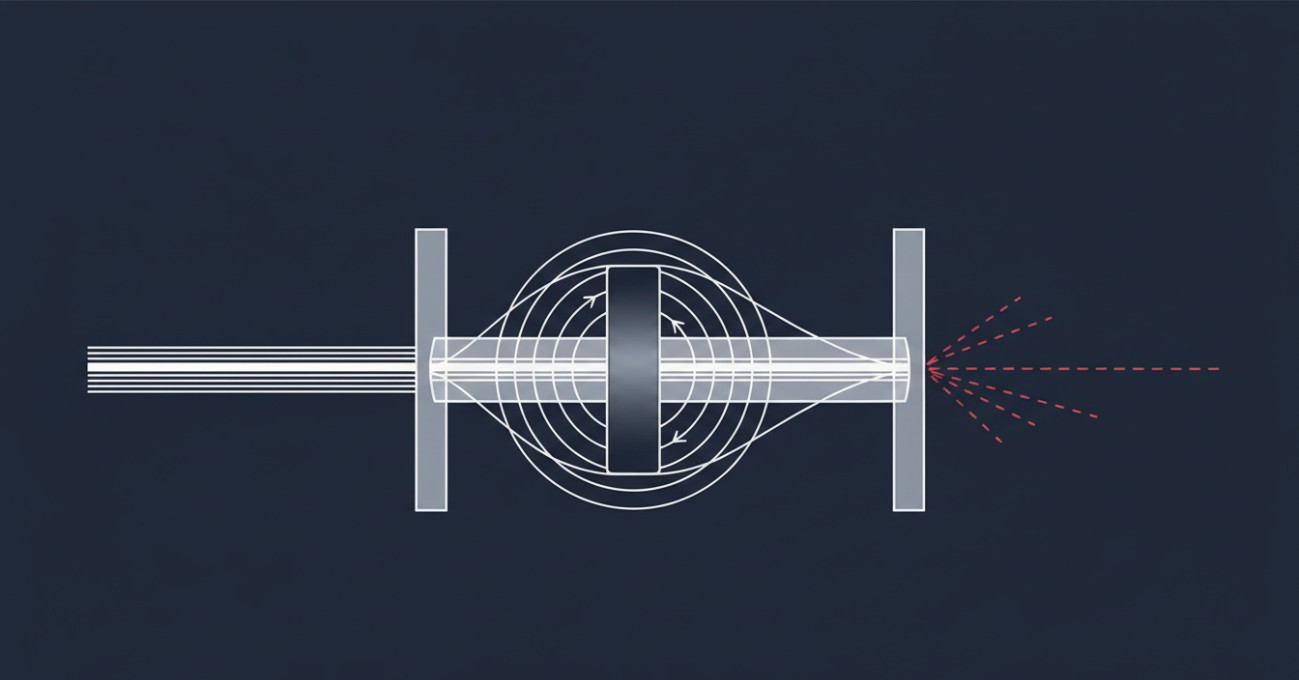 Figure 3. An optical isolator assembly comprising an input polarizer, a TGG Faraday rotator crystal within a permanent magnet ring, and a crossed output polarizer.
Anti-Reflection and Protective Coatings
An uncoated TGG end face reflects approximately 8 percent of incident light at 1064 nanometers. In a high-power laser system, these reflections create parasitic oscillations that destabilize the source and reduce isolation effectiveness. Our coating capability addresses this with designs matched to the operating wavelength and power level.
- Dual-wavelength AR coatings simultaneously minimize reflection at the pump wavelength and the signal wavelength, enabling efficient coupling into the rotator while maintaining high transmission for the rotated polarization state.
- Broadband AR coatings for tunable laser systems maintain low reflection across the full 400 to 1100 nanometer range of TGG transparency, essential for femtosecond and supercontinuum sources.
- Protective encapsulation coatings seal the hygroscopic crystal surface from atmospheric moisture, extending operational lifetime in non-hermetic laboratory environments and field-deployed instruments.
- High-damage-threshold coatings deposited by ion beam sputtering achieve laser damage thresholds exceeding 10 gigawatts per square centimeter for picosecond and femtosecond pulses.
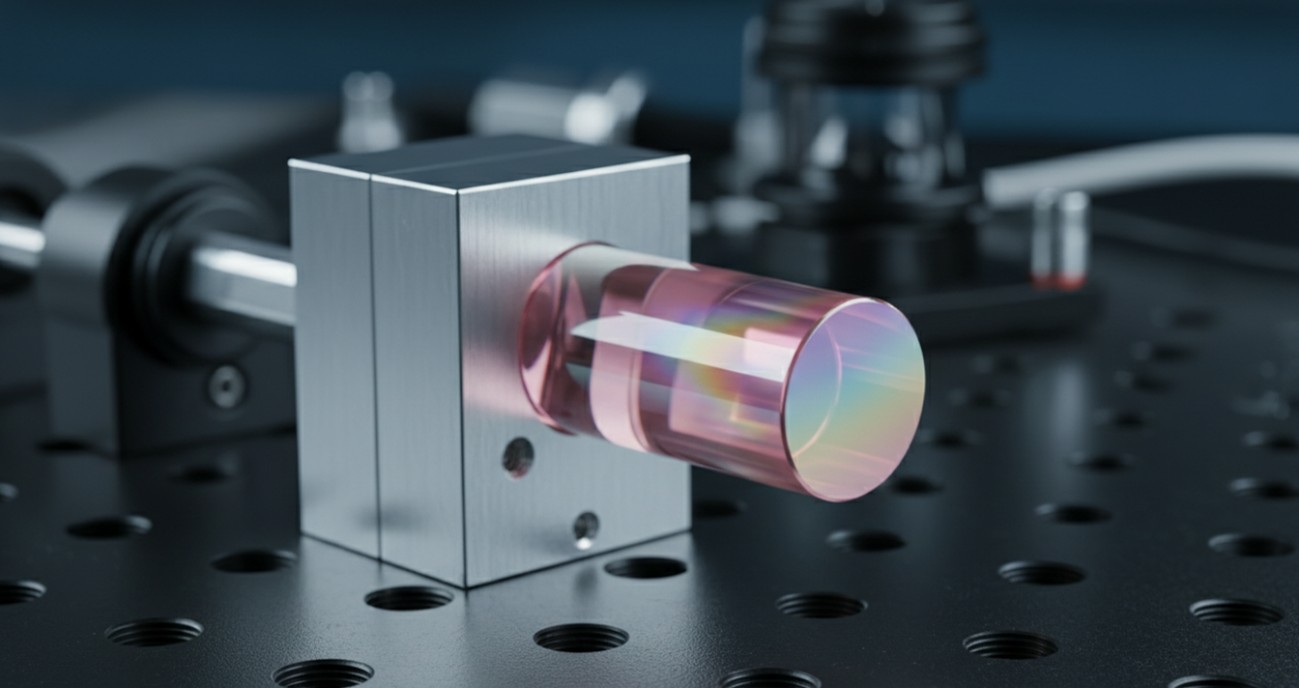 Figure 4. An AR-coated TGG magneto-optical crystal rod mounted in a precision fixture, with the end-face coating showing rainbow interference colors.
Specifications and Achievable Tolerances
Research-grade magneto-optical crystals must satisfy a multidimensional specification space combining crystallographic, dimensional, optical, and magnetic parameters. The table below summarizes the ranges our standard processing workflows routinely achieve.
| Parameter |
Range / Options |
Notes |
| Material |
TGG, TSAG, YIG, BIG, MGO glass |
Custom materials reviewed on request |
| Rod Diameter |
2 mm to 25 mm |
Rectangular and slab geometries available |
| Rod Length |
2 mm to 50 mm |
Determines rotation angle at fixed field |
| Crystallographic Axis |
[111], [100], c-axis |
±0.5° orientation accuracy |
| Surface Flatness |
≤λ/10 @ 633 nm |
λ/20 for high-extinction isolators |
| Surface Quality |
10/5 to 40/20 scratch-dig |
Per MIL-PRF-13830B |
| Parallelism |
< 10 arcsec |
Verified by autocollimator |
| Wavefront Distortion |
< λ/8 @ 633 nm |
< λ/4 for long rods >25 mm |
| Extinction Ratio |
> 30 dB to > 40 dB |
Depends on crystal length and field uniformity |
| AR Coating Reflectance |
< 0.25% per surface |
At design wavelength |
| Damage Threshold |
> 10 GW/cm² |
IBS coatings for ultrafast systems |
| Operating Band |
400 nm to 3000 nm |
Material-dependent |
Research Applications We Enable
Magneto-optical crystals processed at Eata Ray have been integrated into instruments where back-reflection isolation, polarization control, and non-reciprocal propagation are essential. Representative application domains include:
- Laser system protection: TGG-based optical isolators with extinction ratios exceeding 40 decibels and high-damage-threshold coatings for Nd:YAG, Yb-doped fiber, and Ti:sapphire laser chains, preventing back-reflected light from destabilizing the oscillator or damaging pump diodes.
- Ultrafast and high-power laser systems: Compact Faraday rotators with IBS coatings and low-absorption TSAG crystals for chirped-pulse amplifiers, optical parametric chirped-pulse amplification front ends, and petawatt-class laser systems where isolation must survive peak intensities exceeding 10 gigawatts per square centimeter.
- Fiber-optic communication: Miniaturized YIG and BIG-based isolators and circulators for erbium-doped fiber amplifiers, Raman amplifiers, and dense wavelength-division multiplexing systems where back-reflections would create noise and inter-channel crosstalk.
- Quantum optics and atomic physics: Ultra-low-loss Faraday rotators for single-photon sources, atomic-vapor cell experiments, and cavity quantum electrodynamics where any back-reflection would destroy the delicate quantum state.
- Magneto-optical imaging and sensing: Garnet films and bulk crystals for magneto-optical Kerr effect microscopy, domain imaging in magnetic storage media, and current sensors based on the Faraday effect in optical fibers.
- Optical circulators and switches: YIG-based non-reciprocal devices for routing signals in advanced beam-steering systems, optical true-time-delay lines, and reconfigurable optical add-drop multiplexers.
Verification and Characterization
A magneto-optical crystal must be validated at multiple levels before it can be trusted in an isolator assembly. Our metrology suite provides the quantitative data that separates a marginal component from a research-grade one.
Polarimetric extinction ratio measurement determines the contrast between transmitted and rejected polarization states, quantifying the isolator's ability to block back-reflected light. Values exceeding 40 decibels are routinely achieved for TGG rods of 5 millimeter length in uniform magnetic fields.
Phase-shifting interferometry maps the end-face flatness and transmitted wavefront error, revealing the figure deviations that would depolarize the beam and degrade extinction ratio.
Spectrophotometry confirms coating performance, verifying that reflection minima align with the design wavelength and that absorption remains within the specification band.
Laser-induced damage threshold testing at the operational wavelength and pulse duration provides empirical power-handling limits, particularly critical for ultrafast systems where peak intensity dominates over average power.
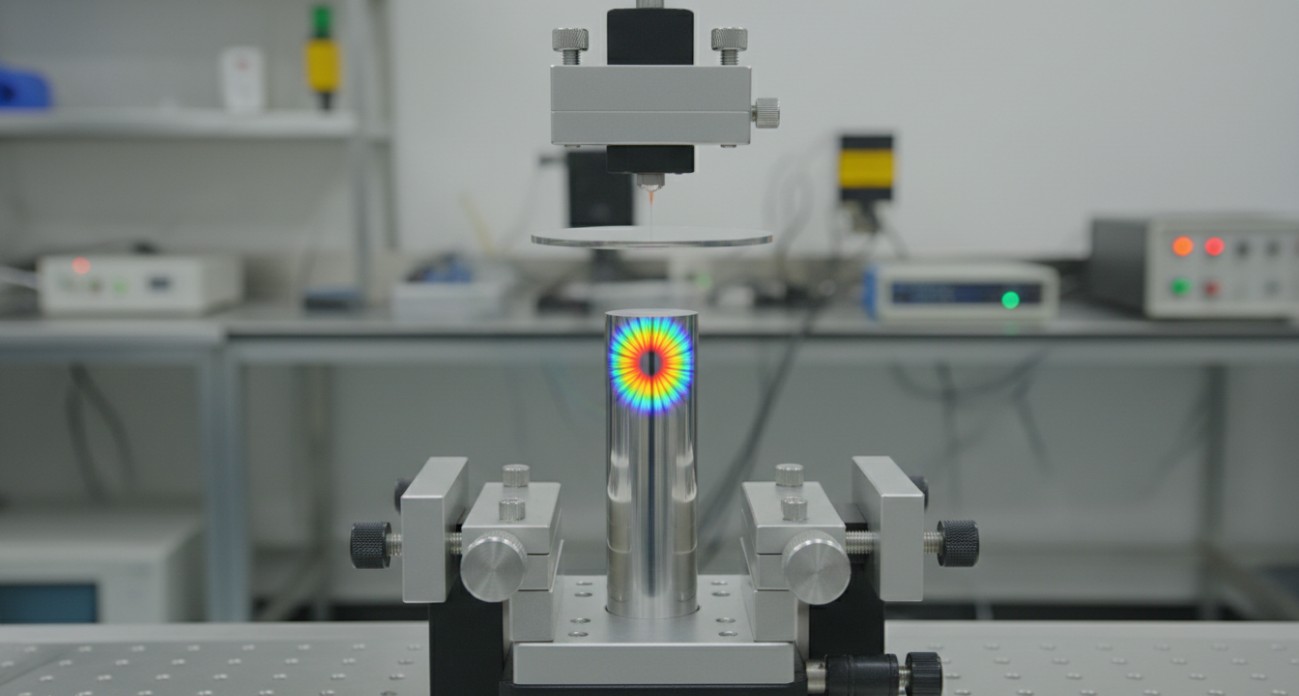 Figure 5. Phase-shifting interferometric testing of a TGG crystal end face, capturing circular fringes that reveal nanometer-level surface flatness deviations.
Collaborative Processing
Research magneto-optical devices are rarely catalog items. The crystal material, length, coating, and magnet assembly must all be matched to a specific laser wavelength, power level, and isolation requirement. Our engagement model is designed for that specificity.
- Technical Consultation: Share your operating wavelength, required rotation angle or isolation level, laser power, and any constraints on device size or magnetic field geometry. If you are unsure which material best suits your application, we advise based on Verdet constant, absorption, and thermal lensing trade-offs.
- Design and Material Selection: Our engineers calculate the required crystal length for your target rotation angle at the specified magnetic field, recommend the most appropriate material, and specify the coating architecture for your wavelength and power level.
- Prototype Fabrication: A single prototype crystal is typically the most prudent first step, especially for high-power or ultrafast applications where damage threshold must be empirically validated. We fabricate, coat, and characterize the component so you can test isolation performance in your optical system.
- Comprehensive Characterization: Each finished crystal ships with a complete inspection report including orientation data, interferometric flatness maps, extinction ratio measurement, coating spectral scans, and damage threshold results where applicable.
- Iterative Refinement: If the prototype reveals a need for adjustment, whether to crystal length, coating wavelength, or protective encapsulation, we modify the design and produce a revised iteration.
Discuss Your Magneto-Optical Requirements
Whether you need a compact TGG Faraday rotator for a Ti:sapphire oscillator, a high-power TSAG isolator for a fiber amplifier chain, or a miniature YIG circulator for an integrated photonics experiment, our team is prepared to translate your isolation specification into a characterized, ready-to-use magneto-optical component.
Reach out with your magneto-optical challenge and receive a tailored technical assessment at no initial charge.


