Custom Solid-State Laser Crystal Fabrication for Research and Advanced Laser Systems
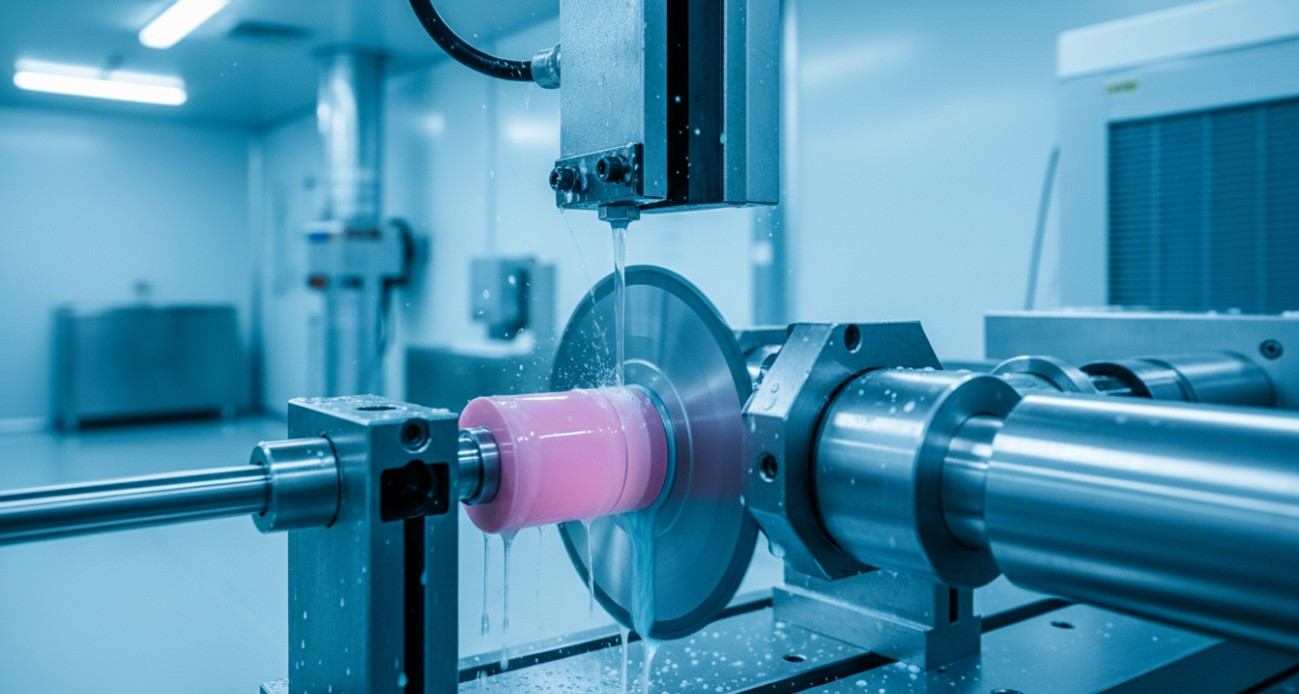 Figure 1. Precision diamond saw slicing a cylindrical Nd:YAG laser crystal boule along the crystallographic axis.
The Surface Where Laser Light Is Born
Every photon emitted by a solid-state laser originates inside a crystalline host, at the interface between the pump radiation and the population-inverted dopant ions. Yet the efficiency, beam quality, and damage threshold of that laser depend just as critically on the physical surfaces that bound the crystal. An end face with 1 lambda flatness introduces wavefront distortion that broadens the focal spot. A subsurface fracture left by aggressive grinding seeds laser-induced damage at intensities well below the material's theoretical limit. A parallelism error of 30 arcseconds misaligns the cavity mode and wastes pump power.
Eata Ray processes laser crystals exclusively for research and advanced instrumentation applications. From orientation-critical cutting through end-face polishing and high-damage-threshold coating, our fabrication pipeline treats every laser crystal as a precision optical resonator element, not merely a doped block.
Processing Chain for Solid-State Gain Media
Laser crystal fabrication combines crystallographic precision with optical surface quality. The crystal must be oriented correctly relative to its growth axis, shaped to the required geometry, polished to laser-grade surface finish, and coated to withstand the operating power density. Our facility addresses each stage with dedicated tooling and metrology.
Orientation-Critical Cutting and Shaping
Most laser crystals are grown with a well-defined crystallographic axis, typically along the [111] or [100] direction for cubic hosts such as YAG and YVO4, or along the c-axis for uniaxial materials such as Ti:sapphire. The laser rod or slab must be cut with its end faces perpendicular to the pump-propagation axis, and often at a specific Brewster angle or wedge for cavity-design reasons.
- X-ray diffraction orientation measurement determines the crystallographic axes of the as-grown boule before any material is removed, ensuring that subsequent cuts align the laser axis correctly.
- Diamond wire saw or inner-diameter blade cutting machines shape rods, slabs, disks, and microchip substrates from the oriented boule, with dimensional tolerances held to 50 micrometers or tighter.
- For Brewster-angle rods, the cylindrical surface is ground at the exact Brewster angle relative to the end-face normal, minimizing reflection loss for p-polarized light without requiring anti-reflection coatings.
End-Face Polishing and Surface Quality
The end faces of a laser crystal are simultaneously optical surfaces and mechanical boundaries. They must transmit or reflect laser light with minimal loss while resisting the thermal and optical loads imposed by the pump and the circulating intracavity field.
- Single-sided pitch polishing on planetary laps achieves end-face flatness of lambda/10 or better at 633 nanometers, with surface quality of 10/5 scratch-dig for high-power applications.
- Subsurface damage removal is critical for laser crystals because residual fractures act as nucleation sites for laser-induced damage. Our grinding-to-polishing sequence uses progressively finer abrasives to ensure that the polished layer extends well below the subsurface damage zone.
- Parallelism between end faces is held to better than 10 arcseconds for rod geometries and better than 20 arcseconds for slab configurations, verified by autocollimator throughout the process.
- Cylindrical barrel polishing removes grinding marks from the rod periphery, reducing scattering and preventing pump-light leakage in side-pumped geometries.
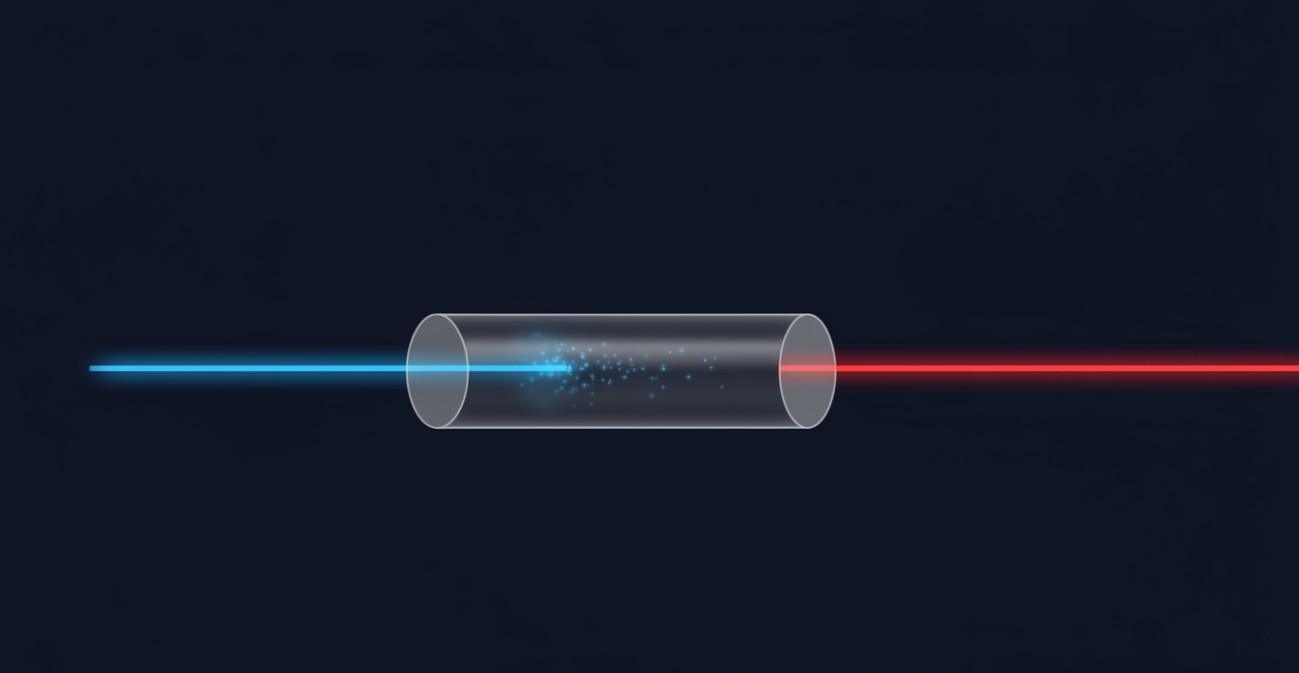 Figure 2. An end-pumped laser crystal rod converting blue pump photons into red output light through stimulated emission in the doped gain medium.
Composite and Diffusion-Bonded Crystals
In high-power end-pumped lasers, the doped region of the crystal experiences intense thermal loading near the pumped face. Composite crystals address this by bonding undoped end caps to the doped gain section, creating a monolithic structure that conducts heat away from the pumped region while preserving optical uniformity.
- Undoped YAG or sapphire end caps bonded to Nd:YAG or Yb:YAG gain sections reduce thermal lensing and peak temperature, improving beam quality and preventing thermally induced fracture.
- Passive Q-switch crystals such as Cr:YAG can be diffusion-bonded directly to the gain medium, creating compact monolithic microchip lasers that require no external modulator.
- Multiple dopant segments with different concentrations can be bonded in series to create a more uniform pump absorption profile along the crystal length, improving extraction efficiency in diode-pumped rod and slab amplifiers.
- The diffusion bonding process requires atomic-level flatness and cleanliness at the interface. Our bonding protocol includes precision surface preparation, optical contact verification, and high-temperature annealing to achieve a mechanically and optically seamless joint.
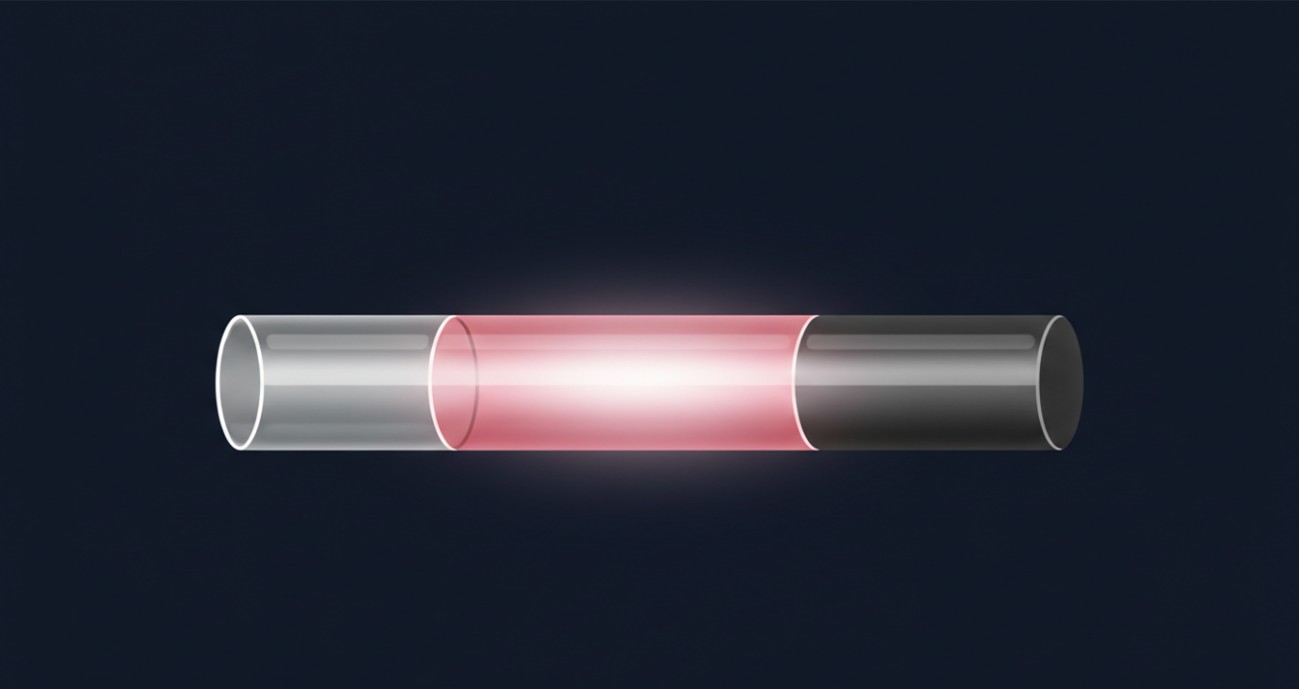 Figure 3. A diffusion-bonded composite laser crystal rod consisting of undoped YAG, Nd:YAG gain, and Cr:YAG saturable absorber segments in a monolithic structure.
Anti-Reflection and Functional Coatings
An uncoated laser crystal end face reflects roughly 8 percent of the intracavity power for a typical refractive index of 1.8. In a high-gain laser, these reflections create parasitic oscillations that deplete the population inversion and destabilize the output. Anti-reflection coatings are therefore not merely desirable but essential for efficient, stable laser operation.
- Single-wavelength AR coatings for fixed-wavelength lasers such as Nd:YAG at 1064 nanometers achieve reflectivity below 0.25 percent per surface with high laser damage threshold, typically exceeding 20 joules per square centimeter for nanosecond pulses.
- Dual-wavelength coatings for pump and signal simultaneously, such as 808-nanometer pump transmission and 1064-nanometer lasing transmission on the same face of an end-pumped Nd:YAG crystal.
- Broadband AR coatings for tunable lasers such as Ti:sapphire and Cr:LiSAF maintain low reflectivity across the full tuning range of the crystal, from 700 to 1000 nanometers or beyond.
- High-reflectivity coatings on microchip laser output faces create monolithic cavities where the crystal itself serves as both gain medium and resonator mirror.
- Protective coatings for hygroscopic crystals such as Nd:YVO4 and KYW prevent surface degradation from atmospheric moisture, extending operational lifetime in unsealed laboratory environments.
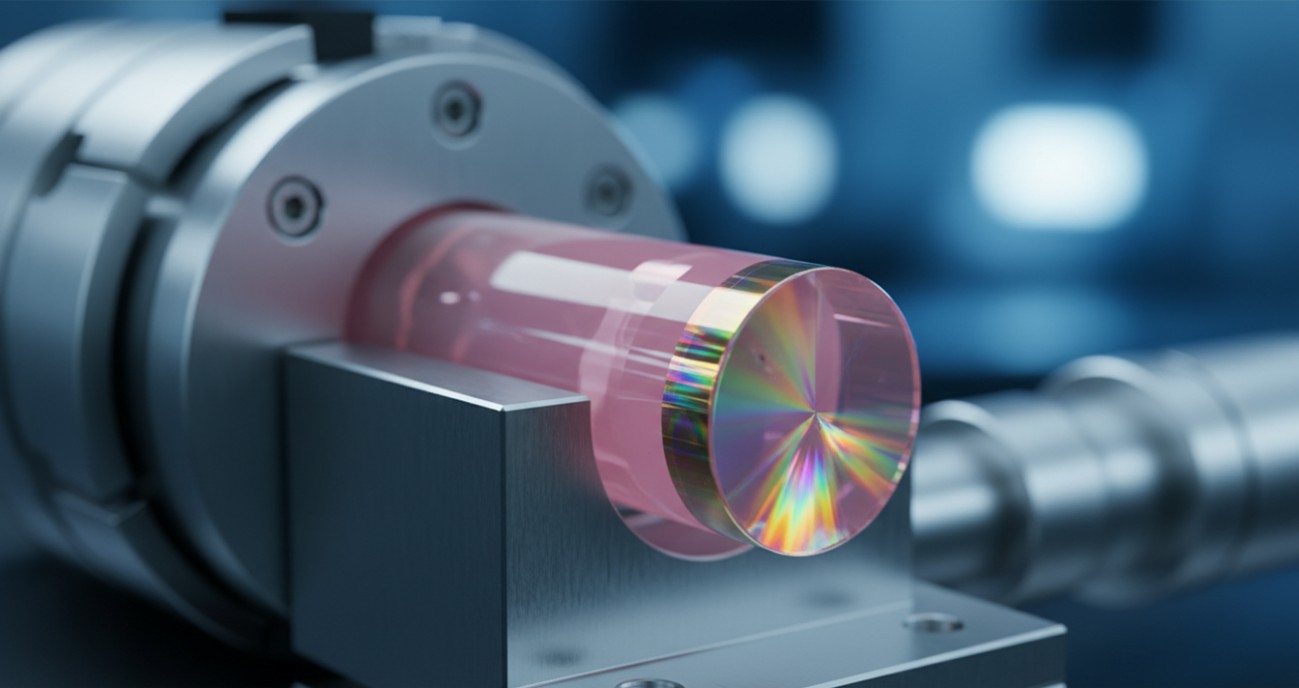 Figure 4. An AR-coated Nd:YAG laser crystal rod mounted in a precision fixture, with the end-face thin-film coating showing rainbow interference colors.
Crystal Materials We Process
Different laser applications demand different gain media. Our processing capability spans the full catalog of commercially available solid-state laser crystals.
- Nd:YAG remains the most widely used solid-state laser medium, offering high gain, excellent thermal conductivity, and mature manufacturing infrastructure. It is the default choice for industrial, medical, and scientific lasers from milliwatts to kilowatts.
- Yb:YAG provides broad absorption at 940 nanometers, a long upper-state lifetime, and minimal quantum defect, making it ideal for thin-disk and fiber-amplifier-pumped high-power lasers with near-diffraction-limited beam quality.
- Ti:sapphire offers the widest tuning range of any solid-state laser, from 660 to 1080 nanometers, with ultrashort pulse capability. It is the gain medium of choice for femtosecond oscillators, chirped-pulse amplifiers, and multiphoton microscopy.
- Nd:YVO4 features a large stimulated emission cross section and strong absorption at 808 nanometers, enabling efficient diode pumping in compact microchip and waveguide configurations.
- Cr:YAG serves as a saturable absorber for passive Q-switching at 1064 nanometers, with absorption recovery times matched to the cavity round-trip period of microchip and compact solid-state lasers.
- Er:YAG and Ho:YAG emit in the eye-safe 1.5-micrometer and 2-micrometer bands, respectively, for medical surgery, atmospheric LIDAR, and materials processing applications where water absorption is advantageous.
- Emerging materials including Yb:KYW, Yb:KGW, and Tm:LuAG are available for frontier research in ultrashort-pulse generation and high-average-power thin-disk architectures.
Specifications and Achievable Tolerances
Research-grade laser crystals must satisfy a rigorous specification space that combines crystallographic, dimensional, optical, and thermal parameters. The table below summarizes the ranges our standard processing workflows routinely achieve.
| Parameter |
Range / Options |
Notes |
| Rod Diameter |
2 mm to 15 mm |
Slab and disk geometries upon request |
| Rod Length |
3 mm to 200 mm |
Microchip configurations down to 0.5 mm |
| Dimensional Tolerance |
±0.05 mm |
Tighter on micro-optic assemblies |
| Crystallographic Orientation |
[111], [100], [010], c-axis |
±0.5°, tighter on request |
| End Face Flatness |
≤λ/10 @ 633 nm |
λ/20 for critical cavity applications |
| Surface Quality |
10/5 to 40/20 scratch-dig |
Per MIL-PRF-13830B |
| Parallelism |
< 10 arcsec |
< 20 arcsec for slab geometries |
| Perpendicularity |
< 5 arcmin |
< 5 arcsec for end-pumped rods |
| Wavefront Distortion |
< λ/8 @ 633 nm |
Depends on rod diameter and length |
| Dopant Concentration |
0.1 to 3.0 at% (Nd:YAG), 2 to 30 at% (Yb:YAG) |
Custom doping profiles available |
| AR Coating Reflectance |
< 0.25% per surface |
At design wavelength |
| Damage Threshold |
> 20 J/cm² @ 1064 nm, 3 ns |
Higher with IBS coatings |
Research Applications We Support
Laser crystals processed at Eata Ray have been integrated into instruments spanning the full spectrum of coherent light generation. Representative application domains include:
- Ultrafast laser systems: Ti:sapphire rods and slabs with lambda/10 flatness and broadband AR coatings for femtosecond oscillators, regenerative amplifiers, and chirped-pulse amplification chains producing terawatt peak powers.
- High-power continuous-wave lasers: Composite Yb:YAG rods and thin-disk gain elements with undoped end caps and dual-wavelength AR coatings for multi-kilowatt near-diffraction-limited industrial and directed-energy systems.
- Q-switched and mode-locked microchip lasers: Diffusion-bonded Nd:YAG-Cr:YAG monolithic cavities with sub-millimeter lengths and super-polished end faces for compact rangefinders, laser-induced breakdown spectroscopy, and seed oscillators.
- Diode-pumped solid-state lasers: Nd:YAG and Nd:YVO4 rods with 808-nanometer pump-transmission coatings and 1064-nanometer laser-line AR for scientific, medical, and micromachining systems.
- Medical and surgical lasers: Er:YAG and Ho:YAG rods with 2-micrometer AR coatings for dermatology, dentistry, and orthopedic surgery where water absorption provides precise tissue ablation.
- Quantum and atomic physics: Ultra-low-loss coated cavities for single-frequency Nd:YAG and Yb:KYW lasers used in optical lattice clocks, atom interferometry, and gravitational-wave detector pre-stabilization.
Verification and Metrology
A laser crystal must be characterized at multiple levels before it can be trusted in a resonator. Our metrology suite provides the quantitative data that separates a usable component from a marginal one.
X-ray diffraction confirms the crystallographic orientation relative to the rod axis, verifying that the laser propagation direction aligns with the intended crystallographic plane for birefringence management and thermal-lensing control.
Phase-shifting interferometry maps end-face flatness and transmitted wavefront distortion, revealing the figure errors that would broaden the focused pump spot or distort the cavity mode.
Autocollimators and goniometers measure parallelism, perpendicularity, and wedge angle to arcsecond precision, ensuring that the crystal aligns correctly within its mount and resonator frame.
Laser-induced damage threshold testing at the operational wavelength and pulse duration provides empirical power-handling limits, verified against calibrated reference samples.
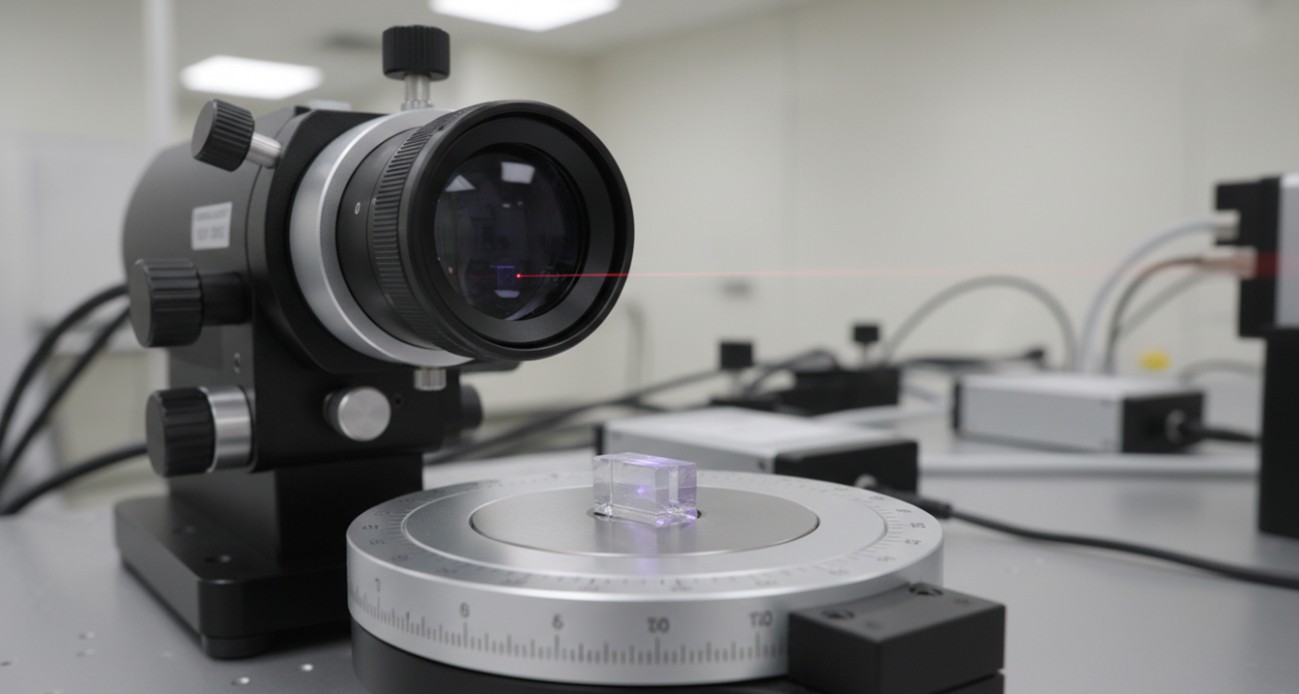 Figure 5. An autocollimator measuring the angular parallelism between end faces of a precision laser crystal rod mounted on a rotation stage.
Collaborative Processing
Research laser crystals are almost never standardized catalog items. The dopant concentration, geometry, coating, and orientation must all be matched to a specific laser architecture and experimental objective. Our engagement model accommodates that specificity.
- Technical Consultation: Share your laser architecture, pump wavelength, desired output power, and any constraints on crystal geometry or mounting. If you are exploring a new material or composite configuration, we advise on dopant concentration, crystal length, and thermal management strategy.
- Orientation and Design Review: For boule-grown crystals, we measure the crystallographic orientation and plan the cutting geometry to align the laser axis correctly. For composite designs, we specify the bond interface locations and end-cap lengths based on thermal modeling.
- Prototype Fabrication: A single prototype crystal is typically the most prudent first step, especially for novel composite geometries or custom doping profiles. We fabricate, coat, and characterize the component so you can validate laser performance in your cavity before committing to a batch.
- Comprehensive Characterization: Each finished crystal ships with a complete inspection report including X-ray orientation data, interferometric flatness maps, surface quality inspection, coating spectral scans, and damage threshold measurements where applicable.
- Iterative Refinement: If the prototype reveals a need for adjustment, whether to dopant concentration, crystal length, coating wavelength, or composite geometry, we modify the design and produce a revised iteration.
Discuss Your Laser Crystal Requirements
Whether you need a single Ti:sapphire rod for a femtosecond oscillator, a composite Yb:YAG assembly for a thin-disk amplifier, or a diffusion-bonded microchip for a Q-switched seed laser, our team is prepared to translate your resonator design into a physical gain medium.
Reach out with your laser crystal challenge and receive a tailored technical assessment at no initial charge.


