Custom Pockels Cell and Modulator Crystal Fabrication for Research and Advanced Laser Systems
 Figure 1. Precision planetary polishing of a rectangular LiNbO3 electro-optic crystal plate on a flatness-controlled lap.
A Voltage, a Crystal, and a Controlled Phase Shift
In 1893, Friedrich Pockels discovered that an electric field applied to certain non-centrosymmetric crystals could alter their refractive index in a linear, reversible fashion. Unlike the quadratic electro-optic Kerr effect, the Pockels effect is first-order in electric field, meaning that the induced birefringence changes sign when the voltage polarity reverses. This linearity makes the Pockels effect the basis of virtually every fast optical modulator, Q-switch, and pulse picker in modern photonics.
Yet the electro-optic coefficient recorded in a material data sheet is only the starting point. The actual performance of a Pockels cell depends on how the crystal was cut relative to its symmetry axes, how its end faces were polished, how the electrodes were deposited, and how the anti-reflection coatings withstand the voltage-induced thermal load. A surface scratch on a DKDP crystal does not merely scatter light; it concentrates the electric field locally, risking electrical breakdown at voltages well below the material's theoretical limit. A misaligned optical axis in a transverse LiNbO3 modulator introduces natural birefringence that competes with the electrically induced retardation, producing temperature-dependent drift that corrupts amplitude stability.
Eata Ray fabricates and processes electro-optic crystals exclusively for research and advanced instrumentation. Every cut, polish, electrode deposition, and coating step is executed with the understanding that the Pockels cell is simultaneously an optical element and a high-voltage electrical component, and that its failure modes are often electromechanical rather than purely optical.
Geometries: Longitudinal and Transverse Field Configurations
Pockels cells come in two fundamental geometries, each imposing distinct constraints on crystal processing, electrode design, and optical performance. Our facility fabricates components for both configurations.
Longitudinal Devices
In a longitudinal Pockels cell, the electric field runs parallel to the optical axis, applied through ring electrodes on the end faces or transparent conductive layers on the entrance and exit surfaces. Because the electrode separation equals the crystal length, the half-wave voltage is independent of aperture size, making longitudinal cells the natural choice for large-aperture Q-switched lasers.
- DKDP and KDP are the dominant materials for longitudinal cells. Their high electro-optic coefficients and optical uniformity enable half-wave voltages of 3 to 7 kilovolts at 1064 nanometers, compatible with standard high-voltage driver electronics.
- Because DKDP is hygroscopic, polished crystals must be protected immediately. Our processing protocol includes nitrogen-purged storage, rapid transfer to the coating chamber, and sealed-housing assembly with desiccant or fluorinated immersion fluid.
- Ring electrodes of silver paste, gold sputter coating, or evaporated chrome-gold are deposited on the end faces, with the clear aperture left uncoated for optical transmission. Electrode edge definition is critical; a conductive film bridging the ring to the aperture creates a shunt path that reduces modulation depth.
Transverse Devices
In transverse Pockels cells, the electric field is perpendicular to the beam path, applied through electrodes on the crystal's side faces. The half-wave voltage scales with the ratio of electrode gap to optical path length, so smaller apertures and longer crystals reduce the required drive voltage.
- LiNbO3 and MgO:LiNbO3 dominate transverse modulators for the near-infrared, offering half-wave voltages below 1 kilovolt for compact apertures. Their non-hygroscopic nature eliminates the environmental sealing requirement, simplifying integration into fiber-coupled and waveguide modulators.
- BBO provides the highest damage threshold and lowest piezoelectric ringing of any common electro-optic material, making it the material of choice for high-repetition-rate Q-switched and regenerative-amplifier systems operating at kilohertz to megahertz rates.
- RTP and KTP combine low half-wave voltage with high resistivity and negligible piezoelectric ringing, enabling precise switching in burst-mode and pulse-picking applications where voltage settling time must be minimized.
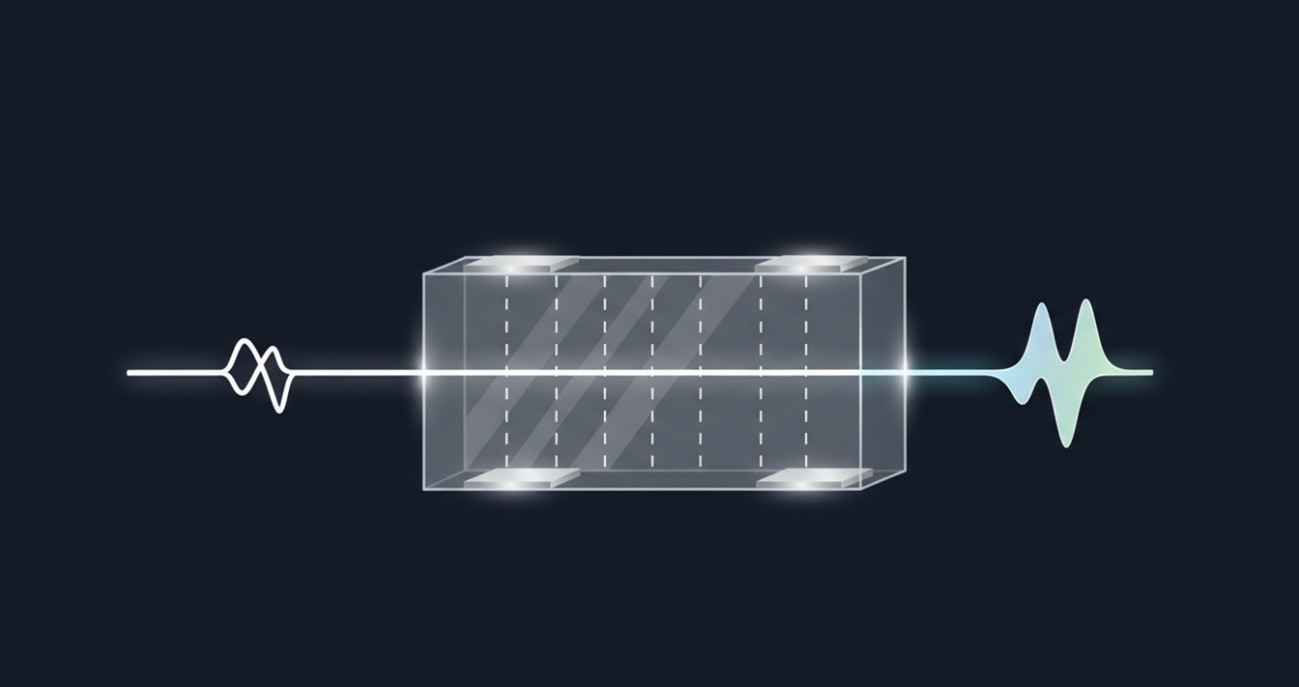 Figure 2. An electro-optic crystal plate between top and bottom electrodes: an applied electric field induces a linear, voltage-reversible change in birefringence.
Processing Chain
Electro-optic crystal fabrication is a multi-stage process in which each operation must preserve the crystallographic orientation, surface quality, and electrical integrity required for high-voltage operation.
- Orientation measurement by X-ray Laue diffraction locates the principal crystallographic axes of the as-grown boule before any material removal. For uniaxial crystals such as LiNbO3, the optical axis must be aligned to within fractions of a degree relative to the cut plane.
- Diamond wire saw or inner-diameter blade cutting shapes the crystal into rectangular plates for transverse cells or cylindrical rods for longitudinal cells, with dimensional tolerances held to 50 micrometers or tighter.
- Single-sided pitch polishing achieves end-face flatness of lambda/10 or better, with surface quality of 10/5 scratch-dig for high-power applications. Parallelism is verified by autocollimator to better than 10 arcseconds, ensuring that the crystal does not introduce wedge-induced beam steering when mounted in the cell housing.
- Electrode deposition uses vacuum-evaporated or sputtered chrome-gold films, silver paste, or transparent conductive oxide layers, depending on the cell geometry and aperture requirements.
- Anti-reflection coatings minimize reflection losses at the operating wavelength. For dual-wavelength Q-switching, coatings are optimized for both the fundamental and harmonic wavelengths simultaneously.
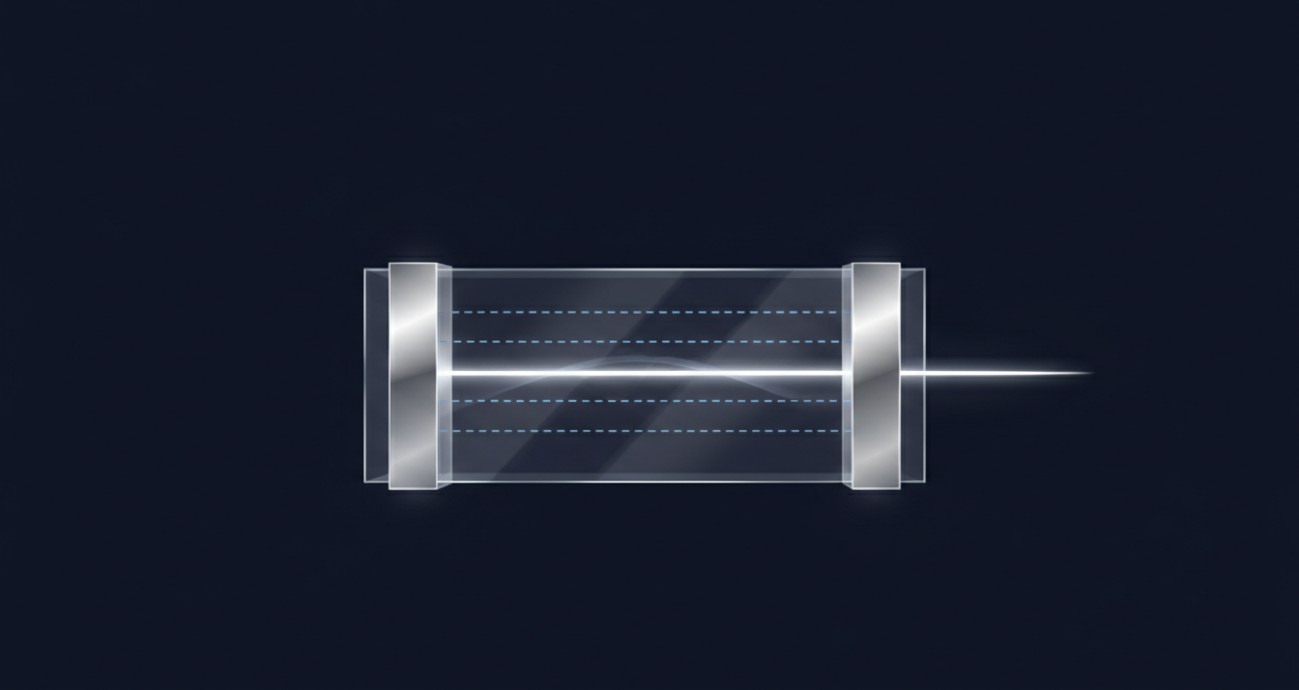 Figure 3. A transverse electro-optic modulator crystal with side electrodes applying an electric field perpendicular to the beam propagation direction.
Material Portfolio
The choice of electro-optic material determines the operating wavelength range, half-wave voltage, damage threshold, and thermal stability. Our processing capability spans the full catalog of commercially available electro-optic crystals.
- DKDP (KD*P) is the workhorse of Q-switched Nd:YAG lasers, offering high deuteration levels exceeding 98 percent, half-wave voltages of approximately 3 kilovolts at 1064 nanometers, and excellent optical uniformity for apertures up to 20 millimeters. Its hygroscopic nature demands sealed housings.
- BBO combines a broad transmission band from 190 nanometers to 3500 nanometers with the highest damage threshold and lowest piezoelectric ringing of any common Pockels material. Its lower electro-optic coefficient requires higher drive voltages, addressed through double-crystal configurations that halve the effective half-wave voltage.
- LiNbO3 and MgO:LiNbO3 provide large electro-optic coefficients and low half-wave voltages, making them ideal for compact fiber-coupled modulators and Q-switches for Er:YAG, Ho:YAG, and Tm:YAG lasers operating near 2 to 3 micrometers.
- RTP offers high resistivity, negligible piezoelectric ringing, and half-wave voltages comparable to LiNbO3, with superior thermal stability and no gray-tracking degradation under sustained high-power operation.
- CdTe and ZnTe extend electro-optic modulation into the mid-infrared, from 2 to 20 micrometers, for CO2 laser systems, quantum-cascade-laser modulation, and infrared countermeasure applications.
- LGS (gallium lanthanum silicate) provides a thermally stable, non-hygroscopic alternative with high damage threshold and stable electro-optic coefficients across a wide temperature range, suitable for harsh-environment laser systems.
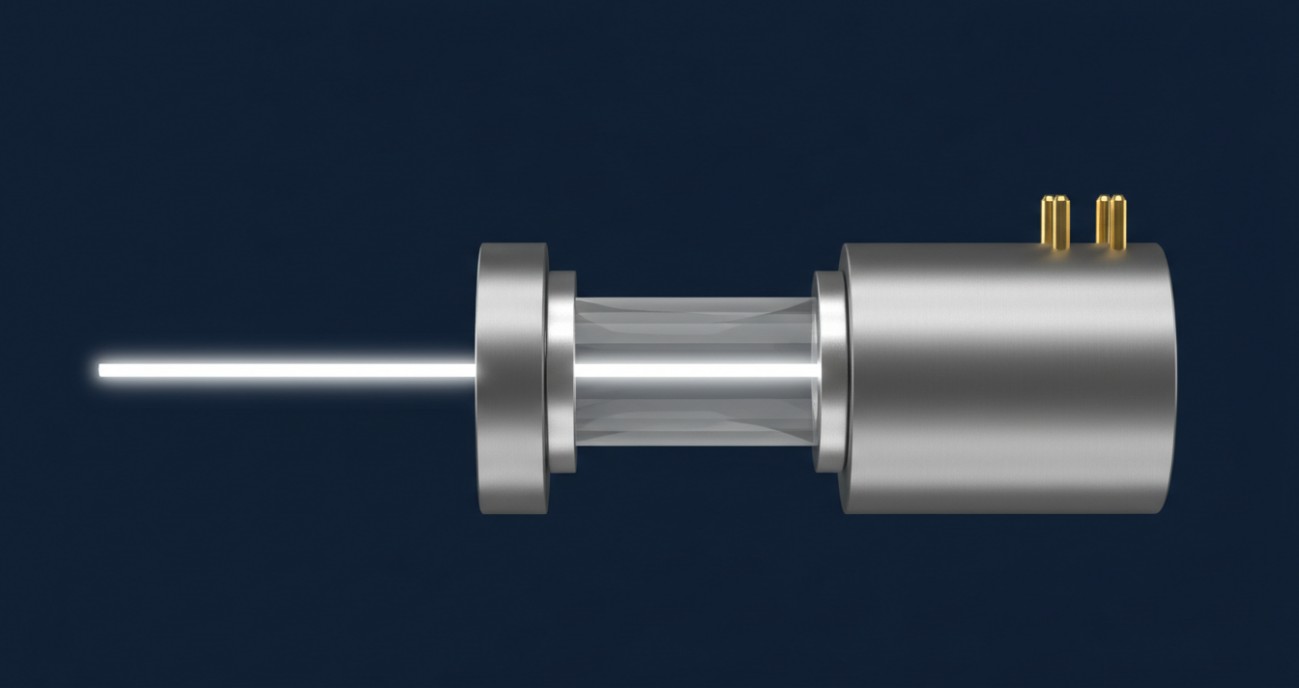 Figure 4. A complete Pockels cell assembly housing a cylindrical DKDP crystal with ring electrodes and electrical feedthrough pins.
Specifications and Achievable Tolerances
Research-grade electro-optic crystals must satisfy a multidimensional specification space combining optical, electrical, and mechanical parameters. The table below summarizes the ranges our standard processing workflows routinely achieve.
| Parameter |
Range / Options |
Notes |
| Crystal Materials |
DKDP, KDP, BBO, LiNbO3, MgO:LiNbO3, RTP, KTP, CdTe, LGS |
Custom materials on request |
| Cell Geometry |
Longitudinal (rod), transverse (plate) |
Ring or side-face electrodes |
| Clear Aperture |
1 mm to 20 mm |
Larger apertures reviewed case by case |
| Crystal Length |
5 mm to 50 mm |
Determines half-wave voltage in transverse cells |
| Crystallographic Orientation |
z-cut, x-cut, y-cut, Brewster angle |
±0.5° via X-ray Laue |
| Surface Flatness |
≤λ/10 @ 633 nm |
λ/20 for wavefront-critical applications |
| Surface Quality |
10/5 to 40/20 scratch-dig |
Per MIL-PRF-13830B |
| Parallelism |
< 10 arcsec |
< 20 arcsec for longitudinal rods |
| Wavefront Distortion |
< λ/8 @ 633 nm |
Verified by interferometry |
| Half-Wave Voltage |
0.5 kV to 7 kV |
Material and geometry dependent |
| Extinction Ratio |
> 500:1 to > 5000:1 |
Crossed-polarizer measurement |
| AR Coating Reflectance |
< 0.25% per surface |
Single, dual, or broadband wavelengths |
| Damage Threshold |
> 300 MW/cm² @ 1064 nm, 10 ns |
Higher for BBO and RTP |
Research Applications We Enable
Electro-optic crystals processed at Eata Ray have been integrated into instruments spanning the full spectrum of fast optical modulation and switching. Representative application domains include:
- Laser Q-switching: DKDP and BBO longitudinal Pockels cells with half-wave voltages of 3 to 6 kilovolts for flashlamp-pumped and diode-pumped Nd:YAG lasers, enabling nanosecond pulse generation with precisely controlled pulse timing and energy.
- Cavity dumping: BBO and RTP transverse cells with sub-microsecond switching times for dumping the entire circulating cavity energy in a single output pulse, producing pulse widths of 1 to 5 nanoseconds at repetition rates to 100 kilohertz.
- Regenerative amplification: Low-insertion-loss DKDP and LiNbO3 cells for coupling seed pulses into and out of regenerative amplifiers, where the Pockels cell serves as both the input switch and the output gate.
- Pulse picking and slicing: RTP and BBO cells with piezoelectric-ring-suppressed designs for selecting single pulses from mode-locked oscillators, achieving contrast ratios exceeding 1000:1 at repetition rates to 10 megahertz.
- Amplitude and phase modulation: LiNbO3 Mach-Zehnder and phase modulators with integrated waveguide electrodes for coherent optical communication, optical frequency comb generation, and lidar waveform shaping.
- Quantum optics and single-photon manipulation: Compact MgO:LiNbO3 and BBO cells for fast polarization rotation in entangled-photon sources, Bell-state measurement, and time-bin encoding for quantum key distribution.
Verification and Electrical-Optical Characterization
An electro-optic crystal must be validated at multiple levels before it can be trusted in a high-voltage cell. Our metrology suite provides the quantitative data that separates a marginal component from a research-grade one.
Extinction ratio measurement under applied voltage quantifies the contrast between transmitted and rejected polarization states, confirming that the crystal achieves the specified half-wave retardation at the rated drive voltage.
Phase-shifting interferometry maps end-face flatness and transmitted wavefront error, revealing figure deviations that would distort the beam and reduce the uniformity of the electric field distribution across the aperture.
Capacitance and resistance measurements characterize the electrical impedance of the cell, ensuring that the driver electronics can charge the crystal capacitance within the required switching time without excessive ringing or overshoot.
Laser-induced damage threshold testing at the operational wavelength, pulse duration, and repetition rate provides empirical power-handling limits, particularly critical for intracavity Q-switch cells where the circulating intensity far exceeds the output beam power.
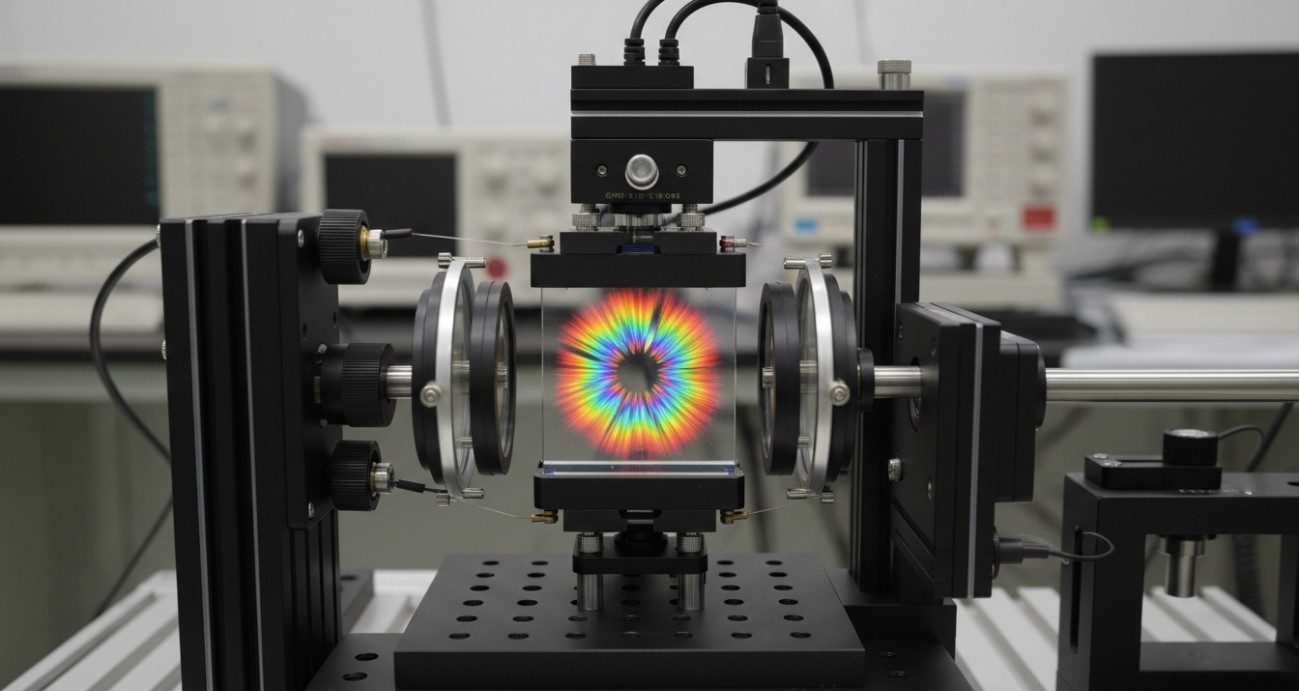 Figure 5. An electro-optic crystal mounted between crossed polarizers in our metrology setup, with interference fringes revealing the electrically induced retardation uniformity.
Collaborative Processing
Research Pockels cells are almost never standardized catalog items. The crystal material, geometry, coating, and electrode configuration must all be matched to a specific laser system, driver electronics, and experimental objective. Our engagement model is designed for that specificity.
- Technical Consultation: Share your laser wavelength, required switching speed, maximum drive voltage, aperture size, and whether the cell will operate intracavity or extracavity. If you are uncertain about longitudinal versus transverse geometry, we advise based on aperture, voltage, and thermal constraints.
- Crystal Selection and Design: Our engineers calculate the half-wave voltage for your chosen material and geometry, specify the electrode design, and model the thermal load under sustained high-repetition-rate operation.
- Prototype Fabrication: A single prototype Pockels cell is typically the most prudent first step. We fabricate, coat, electrode-deposit, and characterize the component so you can validate switching speed, extinction ratio, and damage threshold in your laser system.
- Comprehensive Characterization: Each finished crystal ships with a complete inspection report including interferometric flatness maps, extinction ratio versus voltage curves, capacitance measurements, and damage threshold data where applicable.
- Iterative Refinement: If the prototype reveals a need for adjustment, whether to crystal length, coating wavelength, electrode geometry, or housing design, we modify the configuration and produce a revised iteration.
Discuss Your Electro-Optic Requirements
Whether you need a compact DKDP Q-switch for a flashlamp-pumped Nd:YAG laser, a double-crystal BBO cell for a high-repetition-rate regenerative amplifier, or a fiber-coupled LiNbO3 phase modulator for coherent optical communications, our team is prepared to translate your switching specification into a verified, characterized electro-optic component.
Reach out with your Pockels cell challenge and receive a tailored technical assessment at no initial charge.


