Custom Crystal Fabrication for Frequency Conversion, Parametric Amplification, and Electro-Optic Modulation
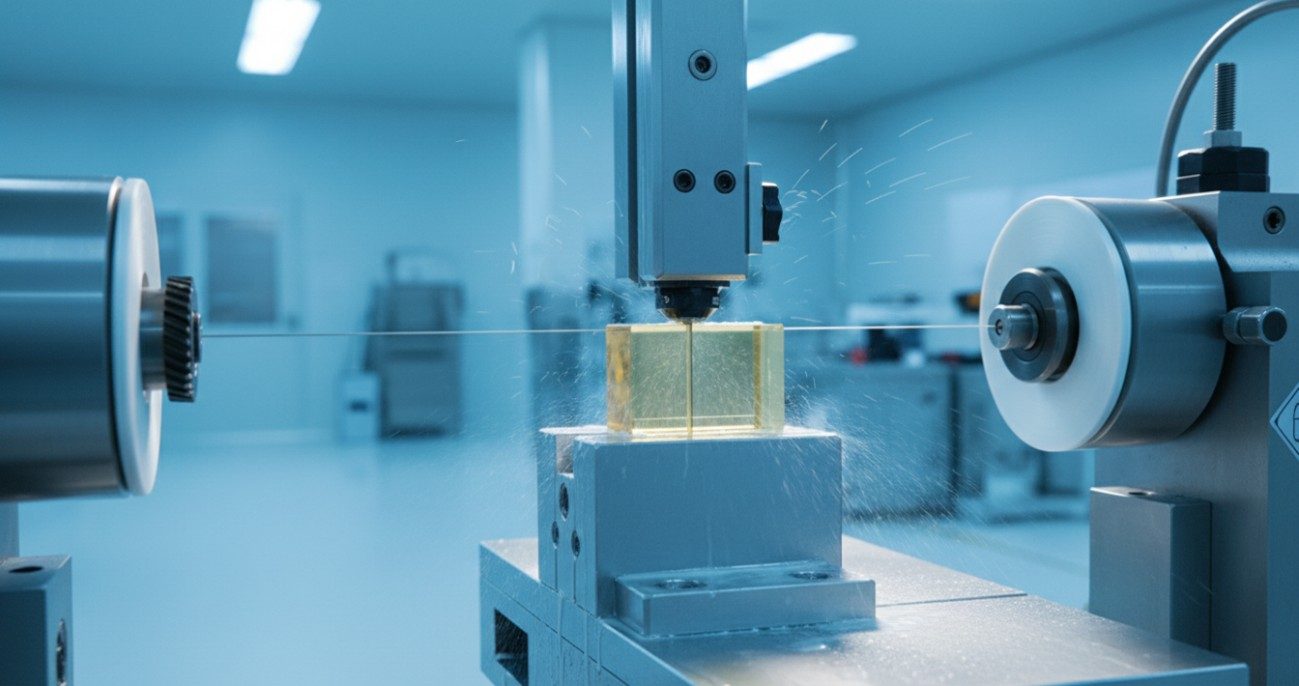 Figure 1. Precision diamond wire saw slicing a nonlinear optical crystal blank along the phase-matching orientation.
When Phase Matching Depends on a Cut
Nonlinear optical processes do not occur automatically. A pump photon does not spontaneously divide into two lower-energy photons, nor does a pair of photons merge into a single harmonic wave, unless the crystal lattice, the beam polarization, and the propagation direction are all aligned to satisfy the phase-matching condition. That condition is not an abstract theoretical construct. It is a physical orientation carved into the crystal, with tolerances measured in fractions of a degree.
Eata Ray specializes in transforming raw nonlinear crystal boules into finished optical components for research laboratories. Every cut, polish, and coating step is executed with the understanding that the crystal's orientation is its most critical specification, and that surface quality, parallelism, and environmental protection are equally essential to maintaining conversion efficiency over the operational lifetime.
From Boule to Finished Crystal
Nonlinear crystal fabrication is a multi-stage process in which each operation must preserve the crystallographic orientation established during growth. Our facility maintains in-house capability across the full processing chain.
Orientation-Critical Cutting
Raw crystal boules arrive with known crystallographic axes, but the final orientation must be established through precision cutting relative to those axes. The phase-matching angle, whether for second-harmonic generation, optical parametric oscillation, or difference-frequency mixing, is determined by the refractive index dispersion of the material and the target wavelengths.
- X-ray diffraction orientation measurement confirms the crystallographic axes before any material removal, establishing a reference frame with sub-degree accuracy.
- Diamond wire saw or inner-diameter blade cutting follows the calculated phase-matching orientation, holding angular tolerances to within 0.25 degrees and often tighter depending on the crystal's angular acceptance bandwidth.
- For biaxial crystals such as YCOB and CLBO, both theta and phi angles must be precisely controlled, requiring orientation in two orthogonal planes before the final cut.
Surface Preparation and Polishing
The optical surfaces of a nonlinear crystal must simultaneously satisfy flatness, surface quality, and roughness requirements. Scatter from surface defects reduces conversion efficiency, while wavefront distortion introduced by poor flatness degrades beam quality in the generated wave.
- Single-sided polishing on pitch laps achieves surface flatness to lambda/10 or better at 633 nanometers, with scratch-dig quality of 10/5 per MIL-PRF-13830B for high-power applications.
- Subsurface damage is minimized through sequential grit reduction, a particularly important consideration for mechanically soft crystals such as KDP and for infrared nonlinear materials such as ZnGeP2 and GaSe.
- For periodically poled materials such as PPLN and PPKTP, the poling electrodes must be precisely aligned with the crystal faces, requiring parallelism and flatness that exceed standard window specifications.
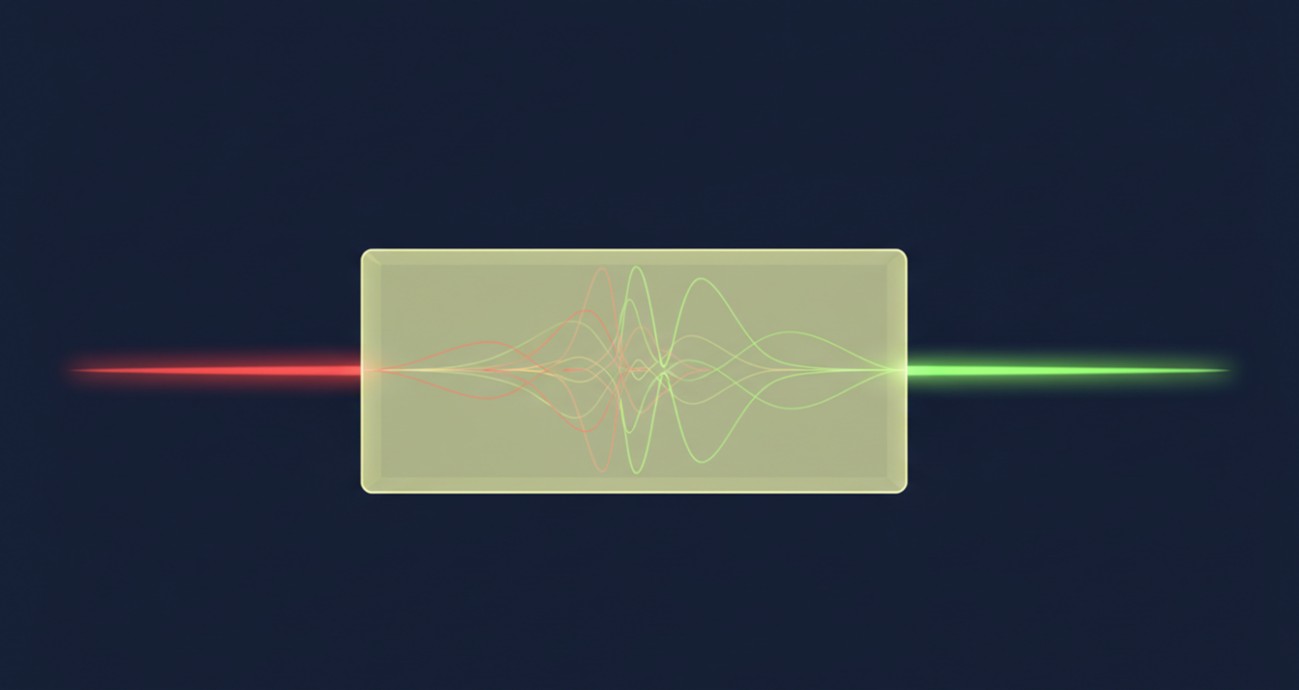 Figure 2. A nonlinear crystal converting infrared pump photons into frequency-doubled green light through the second-harmonic generation process.
Material Portfolio
Different nonlinear processes and wavelength regimes demand different crystal properties. Our processing capability spans the full catalog of commercially available nonlinear optical materials.
- BBO (beta-barium borate) offers wide transparency from 190 nanometers to 3.5 micrometers, broad phase-matching range, and high damage threshold. It is the material of choice for second through fifth harmonic generation of Nd:YAG lasers, optical parametric oscillation, and ultrafast pulse compression.
- LBO (lithium triborate) combines high optical homogeneity with a large acceptance angle and low walk-off, making it ideal for high-average-power harmonic generation and non-critical phase-matching configurations where angular alignment sensitivity must be minimized.
- KDP and DKDP (potassium dihydrogen phosphate and its deuterated analog) remain the standard for high-energy laser frequency conversion, electro-optic Q-switching, and Pockels cell modulation. Their hygroscopic nature demands sealed housing or controlled-atmosphere storage after polishing.
- KTP and its isomorphs (KTA, RTP) provide high nonlinear coefficients and broad temperature-tuning ranges, widely used in OPOs, green laser pointers, and near-infrared difference-frequency generation.
- Periodically poled lithium niobate (PPLN) and lithium tantalate (PPLT) enable quasi-phase-matching across the full transparency range, allowing nonlinear interactions that would be impossible under birefringent phase-matching conditions alone.
- Infrared nonlinear crystals including ZnGeP2, GaSe, and the recently developed BaGa2GeSe6 extend nonlinear frequency conversion into the mid-infrared and terahertz regimes for spectroscopy and remote sensing.
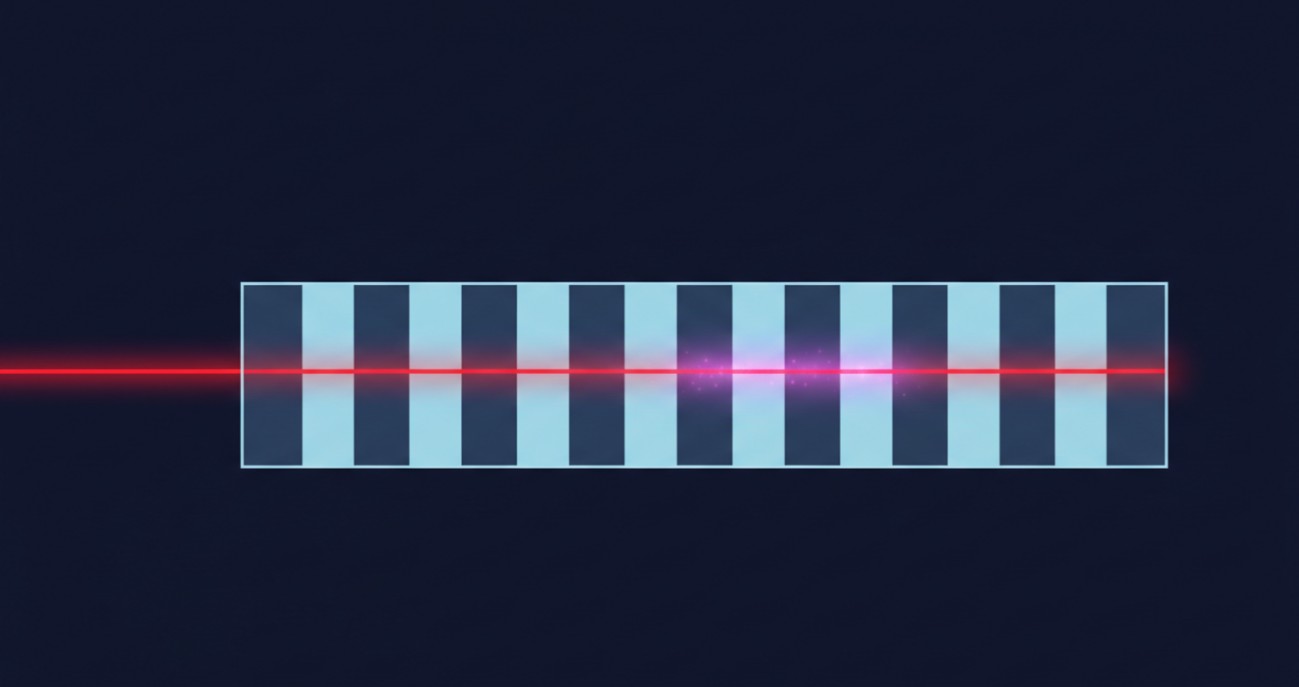 Figure 3. A periodically poled lithium niobate crystal showing alternating ferroelectric domains that enable quasi-phase-matched frequency conversion.
Coatings for High-Power and Broadband Operation
An uncoated nonlinear crystal reflects approximately 4 percent of incident light at each surface. At the intensities required for efficient nonlinear conversion, these reflections represent lost pump power and can seed parasitic oscillations. Our coating capability addresses this with designs matched to the crystal's operating environment.
- Anti-reflection coatings for harmonic generation are optimized for dual-wavelength operation, simultaneously minimizing reflection at both the fundamental and harmonic wavelengths. Ion beam sputtering produces dense, high-damage-threshold films for high-peak-power picosecond and femtosecond systems.
- Broadband AR coatings for OPO crystals maintain low reflection across the entire tuning range, ensuring efficient pump coupling as the crystal angle or temperature is scanned to tune the parametric output.
- Protective coatings and hermetically sealed housings for hygroscopic crystals such as KDP, BBO, and CLBO prevent moisture-induced degradation that would otherwise cloud polished surfaces and degrade optical performance over months of exposure.
- Conductive coatings such as indium tin oxide enable transparent electrode access for electro-optic modulation in Pockels cell and Q-switch configurations.
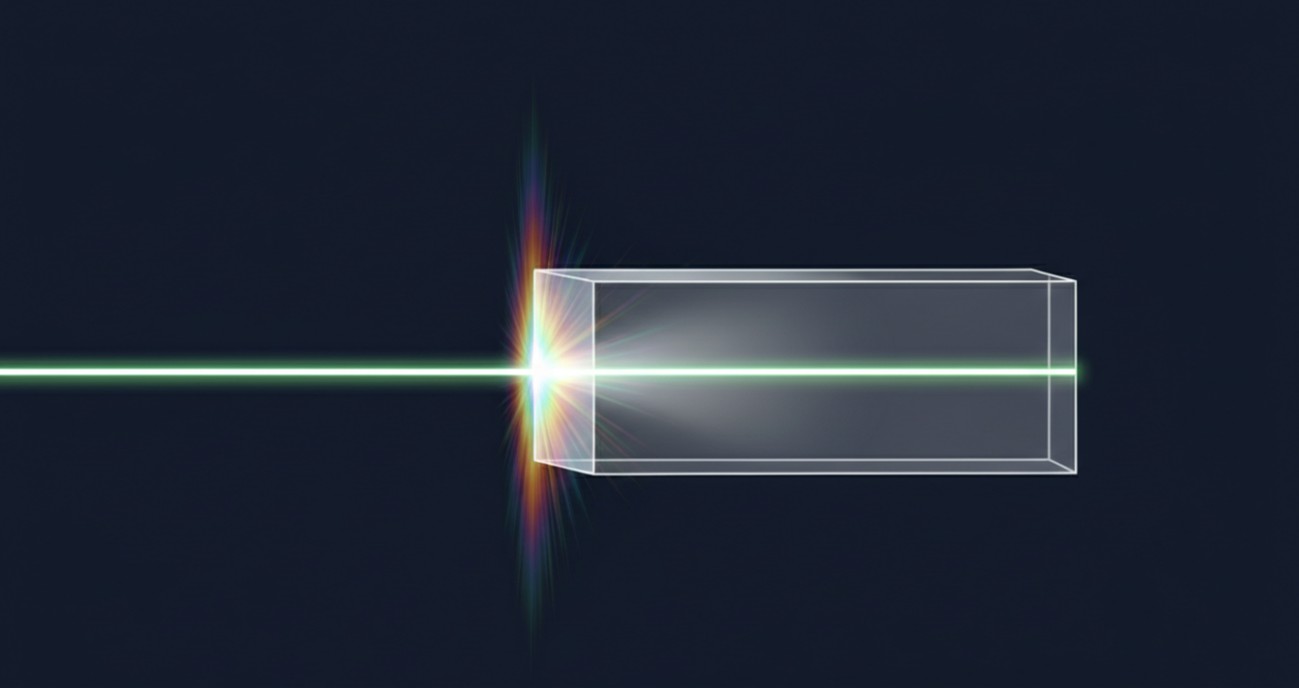 Figure 4. A laser beam entering an anti-reflection-coated nonlinear crystal surface, with the coating layer visible as subtle interference coloration at the interface.
Specifications and Achievable Tolerances
Research-grade nonlinear crystals must satisfy a multidimensional specification space that combines crystallographic orientation, optical surface quality, and environmental stability. The matrix below outlines the ranges we routinely achieve.
| Parameter |
Range / Options |
Notes |
| Crystal Materials |
BBO, LBO, KDP, DKDP, KTP, PPLN, LiNbO3, CLBO, ZnGeP2 |
Other materials reviewed on request |
| Length |
0.2 mm to 50 mm |
Longer lengths for low-gain crystals |
| Aperture |
2 mm to 30 mm |
Clear aperture >90% of cross-section |
| Orientation Tolerance |
Δθ ≤ ±0.25°, Δφ ≤ ±0.25° |
Tighter for narrow-bandwidth crystals |
| Surface Flatness |
≤λ/10 @ 633 nm |
λ/20 available for critical applications |
| Surface Quality |
10/5 to 40/20 scratch-dig |
Per MIL-PRF-13830B |
| Parallelism |
< 20 arcsec |
< 5 arcsec for etalon-sensitive applications |
| Perpendicularity |
≤15 arcmin |
< 6 arcmin for cube-mounted crystals |
| Wedge Angle |
0 to 30 arcmin |
For etalon suppression or beam steering |
| Transmitted Wavefront |
< λ/8 @ 633 nm |
< λ/4 for lengths >10 mm |
| Coating Types |
AR, BBAR, dual-wavelength, ITO, protective |
IBS and ion-assisted deposition |
Research Applications We Enable
Nonlinear crystals processed at Eata Ray have been integrated into instruments pushing the boundaries of coherent light generation and manipulation. Representative application areas include:
- Ultrafast harmonic generation: BBO and LBO crystals with lambda/10 flatness and dual-wavelength AR coatings for second and third harmonic generation of Ti:sapphire and Yb-doped fiber amplifier systems, producing femtosecond pulses in the visible and ultraviolet.
- Optical parametric oscillation and amplification: PPKTP and PPLN crystals with precisely polled domain periods and broadband AR coatings for tunable near-infrared and mid-infrared sources used in spectroscopy and photoacoustic imaging.
- High-energy laser frequency conversion: KDP and DKDP crystals with large apertures, precise phase-matching angles, and sealed housings for harmonic generation in Nd:glass laser chains for fusion energy research.
- Terahertz generation: ZnGeP2, GaSe, and organic DAST crystals cut for difference-frequency mixing and optical rectification, producing coherent terahertz radiation for time-domain spectroscopy and non-destructive testing.
- Electro-optic modulation: DKDP and LiNbO3 crystals with conductive ITO coatings and precise electrode gaps for Q-switching, cavity dumping, and amplitude modulation in pulsed and continuous-wave laser systems.
- Quantum light sources: PPKTP and BBO crystals in non-collinear configurations for spontaneous parametric down-conversion, generating entangled photon pairs for quantum key distribution and Bell-state analysis.
Metrology and Verification
A nonlinear crystal cannot be validated by visual inspection alone. Its performance depends on a combination of crystallographic orientation, surface quality, and coating spectral response that must each be quantified independently.
X-ray diffractometry confirms the crystallographic orientation relative to the polished faces, verifying that the phase-matching angle has been achieved within the specified tolerance.
Phase-shifting interferometry maps surface flatness and transmitted wavefront error, revealing the low-order figure deviations that would distort the pump beam and reduce conversion efficiency.
Spectrophotometry validates coating performance across the design spectral band, confirming that reflection minima align with the fundamental and harmonic wavelengths.
For high-power applications, laser-induced damage threshold testing at the operational wavelength and pulse duration provides the empirical basis for safe operating intensity limits.
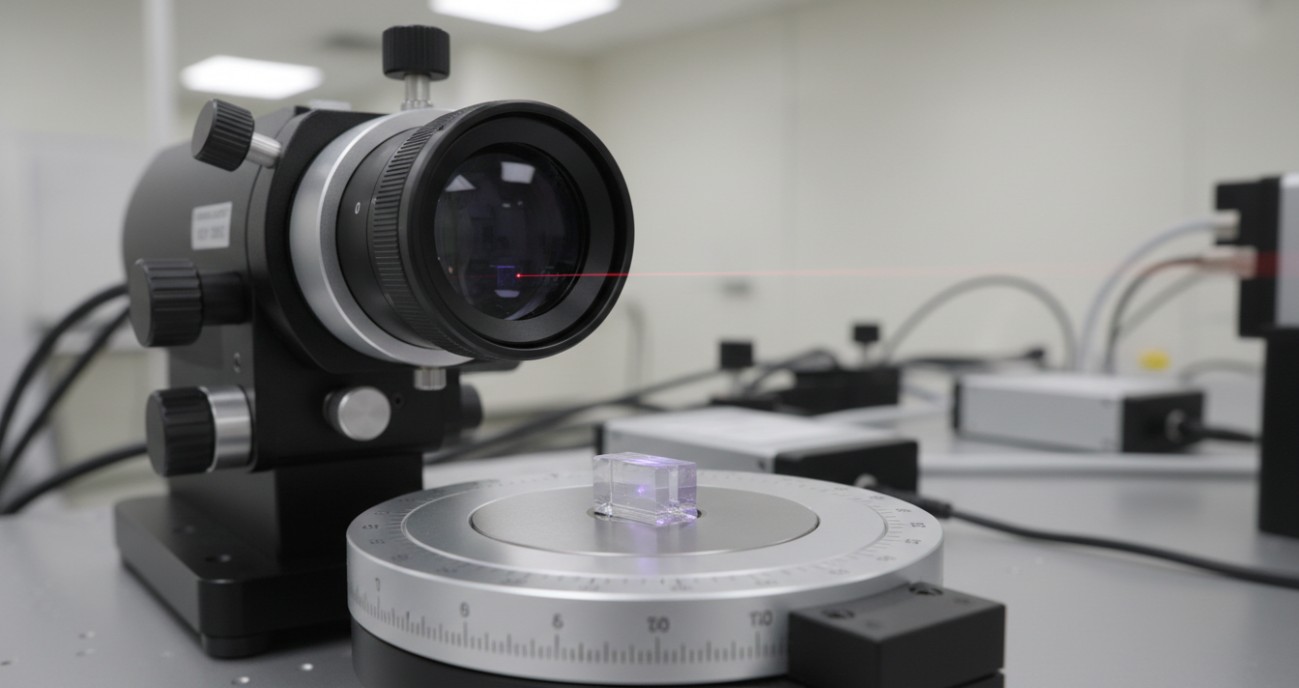 Figure 5. An autocollimator measuring the angular orientation of a nonlinear crystal on a precision rotation stage, verifying the phase-matching cut angle.
Collaborative Processing
Research crystals are almost never off-the-shelf items. The phase-matching angle, crystal length, aperture, and coating must all be matched to a specific laser system and experimental configuration. Our engagement model is designed for that specificity.
- Technical Consultation: Provide your pump wavelength, target nonlinear process, operating power level, and any constraints on crystal length or aperture. If you are unsure which material best suits your process, we advise based on phase-matching bandwidth, damage threshold, and walk-off considerations.
- Orientation Calculation: Using the Sellmeier equations for your chosen material, we calculate the phase-matching angle for your pump wavelength and desired output. For biaxial crystals, both theta and phi are optimized to maximize effective nonlinear coefficient.
- Prototype Fabrication: A single prototype crystal is typically the most prudent first step. We cut, polish, coat, and characterize the component so you can validate conversion efficiency, angular acceptance, and temperature tuning behavior in your laser system.
- Complete Characterization: Each finished crystal ships with a full inspection report including X-ray orientation data, interferometric surface maps, coating spectral scans, and damage threshold measurements where applicable.
- Ongoing Iteration: As your experiment evolves, we stand ready to adjust crystal length, refine orientation, substitute materials, or modify coatings to match changing pump parameters or output requirements.
Discuss Your Crystal Requirements
Whether you need a single BBO crystal for second-harmonic generation, a periodically poled lithium niobate device for parametric down-conversion, or a sealed DKDP assembly for high-energy laser fusion research, our team is prepared to translate your optical prescription into a characterized, ready-to-use nonlinear component.
Reach out with your crystal challenge and receive a tailored technical assessment outlining material selection, phase-matching geometry, achievable tolerances, and a processing path from boule to finished crystal.


